From Laptop Scripts to a Shared Performance-Testing Practice
Move laptop load-test scripts into a shared practice with versioning, environments, data, review, results, access, and explicit gates.
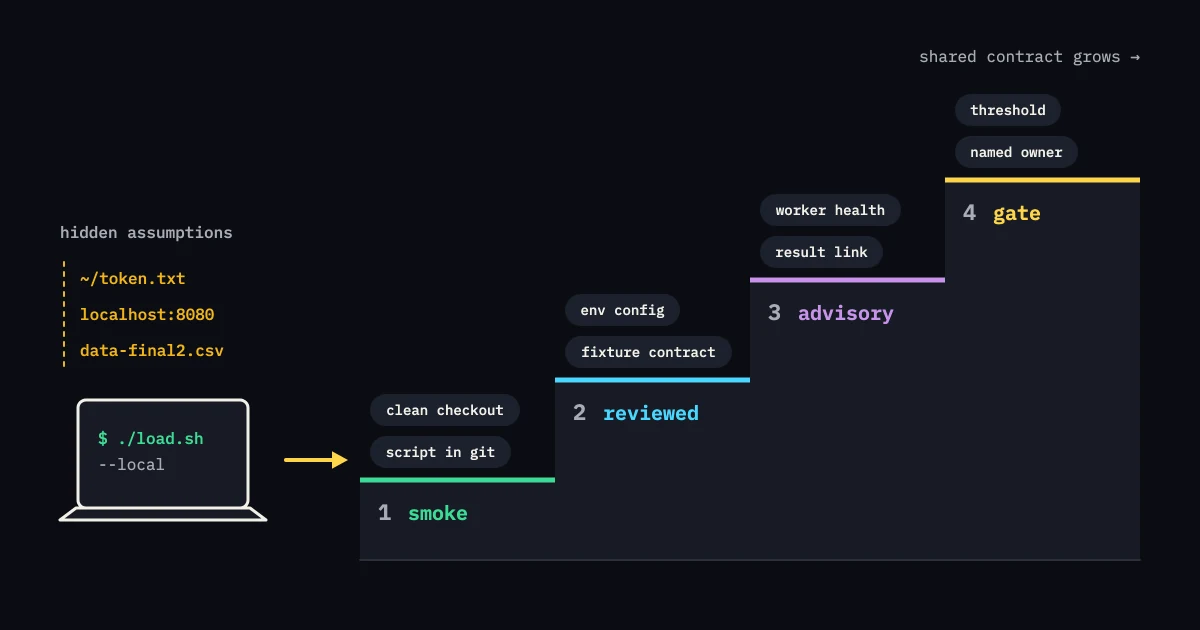
A laptop script is often the first useful performance artifact. It captures a request sequence, tests an idea, and gives an engineer fast feedback. It turns into a team practice once other people can find it, understand its assumptions, run it safely, read comparable results, and know which decision it supports.
A bigger runner does not make that happen. Making hidden choices explicit does. Version the workload, separate environments, control data, review changes, keep evidence, manage access, and add gates only once their signals can be trusted.
Put the script under version control
Store test definitions, commands, properties, fixtures, assertions, and cleanup instructions together. Keep secrets out of the repository, and make missing runtime values fail with a clear error. Record engine and runtime versions so a later run can explain a client change.
Give each scenario a purpose and an owner. A “checkout load test” should say whether it is a smoke, a baseline, a capacity point, or a recovery path. The CI determinism guide covers why inputs and limits need a contract before a check can block work.
Review test changes as behavior changes. A new timer, fixture, correlation rule, payload, or label can change the workload even when nobody touched the application code.
Separate environments safely
Keep the target origin, credentials, data namespace, network route, and approval policy out of the generic scenario. Copying one environment file should never be enough to point a local run at a live target. Make production-like access deliberate and auditable.
Document dependencies and virtualized services. A laptop stub helps while authoring, but a team result should state which latency, errors, quotas, and payloads were real. Private target routes need approved workers and a clear source identity.
Run a safe smoke from a clean checkout. Check the target, labels, assertions, and output before a longer test. If the configuration is invalid, stop instead of generating traffic nobody can interpret.
Make data a first-class artifact
Define fixture setup, ownership, namespaces, lifecycle, and cleanup. Shared read-only data can support a baseline. Mutable flows need unique actors or records. Extract and validate correlated tokens, IDs, and cursors. Do not paste them from a browser session.
Bound random generation and record a seed or a named case. You keep the breadth, and every failure stays reproducible. Redact data in logs and results, and keep only the diagnostics the decision needs.
The correlation guide explains why a missing dynamic value should fail before any dependent traffic goes out. A shared practice cannot depend on one author’s hidden session state.
Create a reviewable execution path
Provide a documented command or workflow with explicit duration, ramp, traffic mix, location, output, and thresholds. The UI helps people find and review runs. A scriptable path makes automation and reproduction possible. Save the expanded configuration as an artifact.
Keep worker health visible. On a laptop, one machine may be both the authoring environment and the generator. A shared run should report whether its workers applied the intended pressure, and it should tell target failures apart from client or network failures.
Make cancellation safe. Stopping a run should stop new work, drain or bound in-flight work, flush results, and release workers. Test an interrupted run as well as a green one.
Give results a home
Keep operation labels, percentiles, throughput, error classes, assertions, resource context, run identity, commit, environment, and generator health. A screenshot helps a conversation. It is not durable evidence. Link each result to the change or release that prompted it.
Compare like with like. Keep scenario version, data, cache, location, and runtime visible. The run comparison guide explains how to avoid mistaking changed inputs for regressions.
Make access useful and safe. Developers should be able to inspect the failing operation. Security and operations should control who can run against sensitive targets and who can view data. Build permissions around the create, run, review, cancel, and delete actions.
Introduce gates carefully
Start with advisory checks while the baseline and environment settle. Use explicit criteria such as assertion failures, operation-level latency, error segments, and worker health. Keep exploratory capacity runs apart from pull-request checks.
People learn to bypass a gate that fails at random. When yours fails, publish the run link, commit, scenario, observed value, rule, and generator status. If a result is inconclusive, quarantine it with an owner and an expiry date. Do not retry quietly until it goes green.
Share ownership
Developers should add scenarios for the paths they change. Platform or performance specialists should provide the paved execution path, fixtures, and analysis patterns. SRE and QA should question assumptions and tie evidence to operational risk. The CI execution guide shows how to make that split repeatable.
Teach the practice with examples: one safe smoke, one realistic baseline, one controlled failure, and one result comparison. Make the workflow usable by people who did not write the first script.
Scale the practice deliberately
Set a promotion path for a script. First, a safe smoke proves the journey and assertions. Next, a reviewed scenario runs against a controlled environment with owned data and an explicit stop condition. Last, a scheduled or release-linked run gets a named owner, retained evidence, and a follow-up rule. At each stage, record what becomes shared: the script, environment configuration, fixture contract, credentials boundary, result location, and decision threshold. The team should be able to pause or retire a scenario and still know why it existed. This path keeps the laptop useful for exploration and stops private assumptions from becoming a hidden dependency in a release process. New contributors also get a clear way in: they can improve one contract or one piece of evidence without learning every operational detail first.
Do not migrate every laptop script at once. Pick a critical flow, clean up its data and assertions, run it from a shared path, and review the artifact. Add the next scenario only once ownership and cleanup are clear. A small suite you trust is more useful than a large collection nobody can interpret.
Use a short readiness review for each migrated scenario. Another engineer can run it. The target and credentials are explicit. Fixtures are safe and repeatable. Dynamic values are validated. Labels and assertions mean something. Worker health is visible. Cancellation is safe. The result links to its commit. If any item is missing, keep the scenario advisory and close the gap before you add it to a blocking workflow.
Repeat the review after a real change in target route, data model, engine version, or team ownership. A shared practice scales when its contract stays visible through changes. Copying a script that was once clean into a bigger collection does not scale it.
Keep a migration log of the assumptions you removed: local paths, hidden variables, tokens refreshed by hand, unbounded data, and missing cleanup. The log shows the team its progress and keeps a convenient workaround from sneaking back into the next scenario.
Name an owner who reviews that log when the scenario changes. The practice stays shared only if someone notices drift and asks for evidence before the next team run.
The review can be a short checklist on the pull request, as long as it names the scenario and the result instead of only confirming that a file changed.
