Correlation in Load Testing: Dynamic Tokens, IDs, and Multi-Step Flows
Build reliable correlated load tests by extracting dynamic tokens and IDs, validating them, and failing loudly when a dependency is missing.
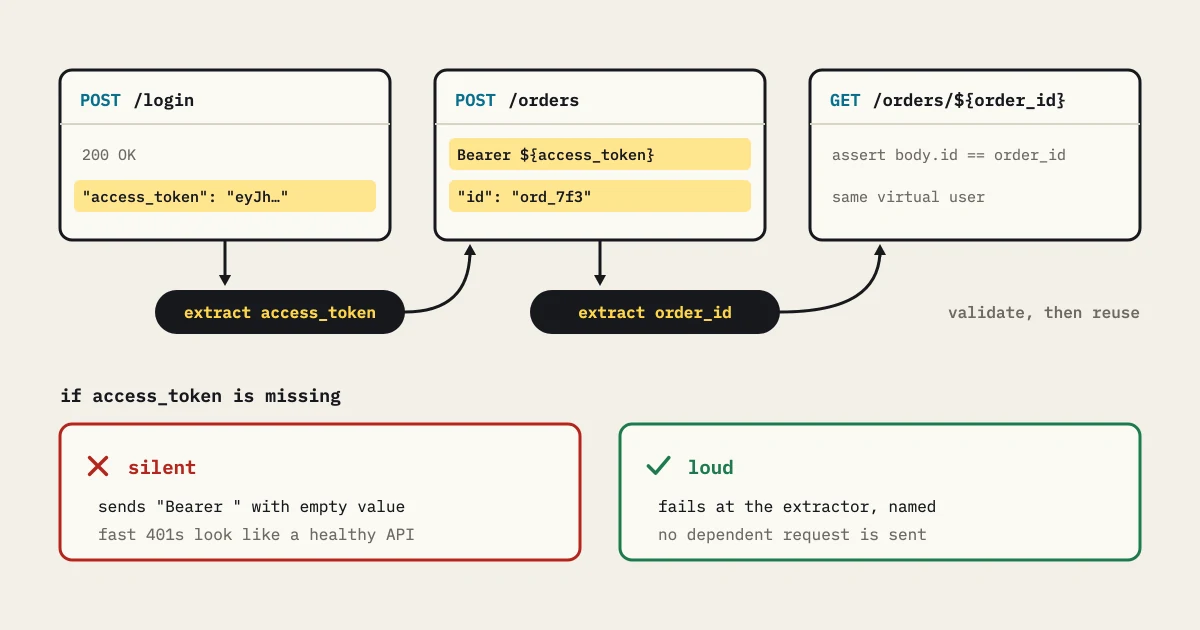
Correlation means carrying a value from one step of a load-test flow into the next. A login response returns a token. A create request returns an ID. A pagination response returns a cursor. The next request needs that value, extracted, validated, and reused for the same virtual user. If your test swaps the value for a constant, it may keep sending traffic while it stops representing the product flow.
Treat every dynamic value as a dependency with a lifecycle. Find out where it is created, what shape it has, who may use it, how long it stays valid, and what should happen when it is missing or expired.
Map dependencies before scripting
Draw the journey as a data flow, not only as a list of requests. For each step, mark the inputs that come from fixtures, the outputs a later step consumes, and the values that are independent on purpose. Authentication tokens, CSRF values, resource IDs, signed URLs, cursors, and version headers often cross step boundaries.
Name the source and the consumer in the scenario. “Token” tells you less than “access token from the login response, used by the order request.” With names like that, a missing extractor is easier to diagnose, and a new engineer is less likely to paste in a sample value because its purpose was unclear.
The API performance test guide explains how to keep journeys meaningful. Correlation turns the request sequence into the same per-user conversation the service expects.
Extract narrowly
Extract from a stable, documented response field or header. Use a parser that understands the response format rather than a broad regular expression that can match the wrong text. Bound the search, and fail when more than one candidate shows up unexpectedly. A loose extractor can return an ID that has valid syntax but is the wrong value.
Validate right away. Where you can, check presence, type, allowed shape, and the link to the current actor or resource. Do not wait for the next request to return an authorization error. The failure belongs at the extraction boundary. A good error names the producer, field, and scenario case that failed, without printing the secret or the full response.
Keep extraction apart from transformation. If a cursor must be URL-encoded or a token needs a prefix, name that transformation and test it. A conversion hidden in a string template makes a later protocol or client change hard to review.
Reuse within a virtual user’s scope
A value one user created should not leak to another. Store correlated state in the smallest scope that matches the product: a request, a session, a virtual user, or a controlled shared fixture. Shared mutable state can make a test pass by letting one user consume another user’s resource, and it produces authorization and contention patterns that cannot happen in production.
For an ID-based flow, create a resource in setup, carry its ID into the read and update steps, and assert that the response belongs to the same namespace. For a cursor flow, use the cursor from the previous page and assert that the page advances or ends as expected. Never loop on a fixed first-page cursor unless the test is explicitly measuring repeated-cache behavior.
Handle expiry and refresh
Tokens and signed URLs expire. If users hit the product’s refresh path, a long run should model it. Keep initial authentication separate from refresh, and record which path produced each failure. Test an expired token as a deliberate negative case, then check that the client refreshes or signs out as the contract says.
Do not refresh silently on every error. That can hide a server regression and add authentication load nobody planned for. Classify status and assertion outcomes, apply a bounded policy, and count attempts. The error-rate guide explains why a recovered request should not erase the original failure signal.
Correlate GraphQL and streams
GraphQL variables often carry IDs, cursors, and mutation outputs. Assert that the next query uses the identifier a mutation returned, and that the query checks the expected object. A successful GraphQL envelope can still hold field errors, so validate both the dependency and the result.
In streaming protocols, correlation may cover a subscription ID, resume token, room, or sequence marker. Keep subscription state bounded, and assert ordering or replay behavior only where the product promises it. A stream that stays connected but receives another user’s event is a correctness failure, not a latency data point. GraphQL load testing covers the related concerns about operation shape.
Test missing values loudly
In a safe test environment, add a fixture or response that is broken on purpose. Confirm that the extractor fails before any dependent traffic goes out, that the result names the missing dependency, and that cleanup still runs. This guards against a common silent failure: a template substitutes an empty string, the server returns a fast 4xx, and the load report describes a healthy low-latency endpoint.
Tell missing, malformed, expired, unauthorized, and not-found values apart. Each one points to a different owner. Keep status and assertion labels, and do not log credentials, personal data, or full signed URLs. A good error is specific enough to debug and limited enough to share.
Keep data preparation consistent
Correlation depends on state. Prepare fixtures through supported interfaces or a safe, versioned setup. Record whether resources are shared or per user, and define cleanup. If one test’s first request creates data that another test assumes already exists, run order becomes a hidden dependency.
Use bounded namespaces and deterministic cases where you can. Random IDs can widen coverage, but you need a seed or a named case to reproduce a failure. Make the cost of creating data visible. Do not bury a large setup workload inside the measured user journey unless that is the behavior you are studying.
Review the flow as a contract
Review a correlated scenario the way you would review an API contract with state transitions. Name the producer of each value, the consumer that needs it, the validation that proves it is usable, and the cleanup that removes the fixture. Check a token taken from a response for presence and shape before it becomes an authorization header. Tie each identifier to the virtual user’s data namespace, so no user can pass a test by reading someone else’s object. For pagination, assert that the cursor advances and that the end condition can be reached. For retries, decide whether the same token may be reused or a fresh one is required. These checks make failures immediate and local. Without them, one missing extraction can cascade into a run of unauthorized requests, and the report may blame a downstream service for a bug in test state management.
For each dependency, review the producer, extractor, validator, scope, consumer, expiry, negative case, and redacted diagnostic. Put these details in the scenario documentation. When an API changes, update the producer and the consumer together and run the broken-extraction case.
Correlation is how a test represents a dependency graph. Clever string handling has little to do with it. When a dependency is invalid, fail loudly before the script produces traffic no real client could send.
As a review exercise, break the token extractor in a safe fixture and read the report. You should see an immediate, named failure, no dependent request with an empty authorization value, and a cleanup record. Then restore the fixture and check that two virtual users cannot consume each other’s IDs. These small tests show that the script represents a real client flow and does more than produce output shaped like requests.
