Who Owns Performance Testing? A Team Operating Model That Works
Build a practical performance-testing operating model where developers, platform, SRE, and QA share responsibility without ownership gaps.
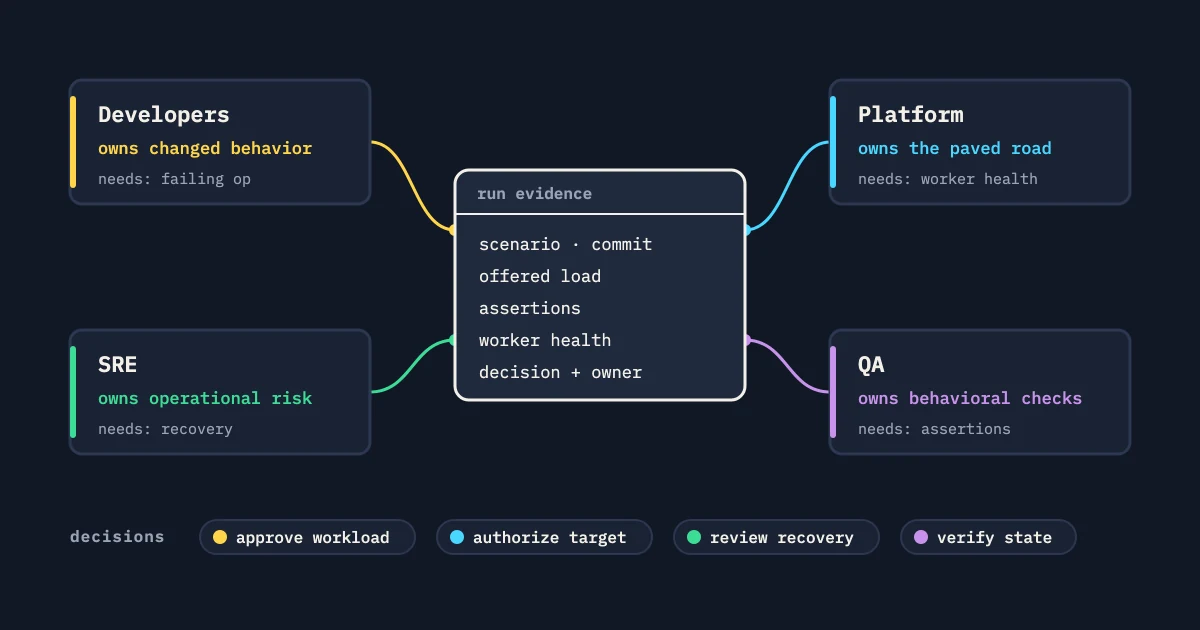
Performance testing works best as a shared operating model. It works badly as a ticket handed to one specialist at the end of a release. Developers understand the changed code and its likely workload. Platform teams provide a safe, repeatable way to run tests. SRE brings production risk and recovery questions. QA challenges behavior and coverage. One group can coordinate, but no group can hand off the meaning of the result.
The model below assigns responsibilities without building a performance department that turns into a bottleneck. Adapt it to your team size, and give every action and decision an owner.
Developers own changed behavior
The developer or service team identifies the paths whose performance may change, provides representative fixtures, and adds or updates assertions. They know the operation’s contract, data shape, and likely downstream dependencies. Owning this does not mean running every worker. It means you cannot treat performance as someone else’s interpretation problem.
For a changed endpoint, the team states the expected traffic, the latency or error criteria, data conditions, and risks. A small smoke can run in CI once it is stable. Deeper capacity or recovery tests can run in a controlled environment. The deterministic CI guide explains why those levels should stay separate.
Developers also own the follow-up on a named regression. A generic “performance failed” ticket with no operation or hypothesis just sits in a queue. Nobody is responding to it.
Platform owns the paved road
Platform or performance-infrastructure owners provide test execution, worker lifecycle, target access, safe defaults, result storage, telemetry links, and documented limits. They make the correct path easy and the unsafe path hard. They do not own each scenario’s business meaning.
The paved road covers cancellation, worker health, partial results, cleanup, secret handling, and access control. A platform that only starts traffic pushes the hard operational work back onto each product team. The distributed architecture guidance lists the lifecycle boundaries to make visible.
Platform owners publish how to request private routes, how data is isolated, how to read generator failures, and how to escalate a platform incident.
SRE owns operational challenge
SRE challenges whether the workload covers production risk: peak shape, dependencies, quotas, retries, failover, recovery, and observability. They ask what the result does not prove and whether the service has a safe degradation policy.
SRE does not need to approve every exploratory run. Match their involvement to the risk, with release or event reviews for critical paths. Include the signals responders would use during the test, and ask whether the runbook can tell target failure from generator failure.
Recovery matters most here. A green steady-state run says little about reconnect storms, worker loss, or load from a restored dependency unless you tested those cases on purpose.
QA owns behavioral challenge
QA challenges assertions, journey coverage, data setup, negative cases, and the gap between transport success and product success. QA makes sure a test cannot pass by sending requests while the user-visible state is wrong.
QA also helps keep expected protection behavior apart from unexpected failure. A deliberate 429 or authorization rejection may prove a guard works. Do not mix it into ordinary success criteria. The error-rate guide describes a segment-aware approach.
QA also reviews whether a recorded journey became a durable script. Correlation, pacing, cleanup, and reproducibility matter as much as the request sequence.
Create explicit decision ownership
Name who can approve a workload, authorize a target, interpret a failed gate, cancel a run, accept residual risk, and schedule follow-up. These are separate actions. A single “performance owner” label often hides the gap between running a test and deciding what its result means.
Use a lightweight RACI-style table if it helps, but tie it to real workflows. For a pull request, the service owner may approve an advisory smoke. For a launch, SRE and platform may review capacity, edge controls, and recovery. For a tool change, security may own the network and data boundary.
Make evidence shared
Store the scenario definition, commit, environment, data, location, offered load, results, assertions, worker health, and decision together. Link to live telemetry, but do not make the dashboard the only record. The Prometheus, Grafana, and report guidance covers that separation.
Give each group the view it needs. Developers need operation-level failures and a way to reproduce them. Platform needs worker and lifecycle evidence. SRE needs saturation and recovery. QA needs assertions and state. One shared artifact can serve all four without turning into an unreadable dump.
Build a progression of responsibility
Start with a template for one critical path. The service team fills in intent, data, and criteria. Platform validates execution and access. QA checks assertions. SRE challenges the risk for that test tier. Review the result together once, then let the service team own routine changes.
Teach with training and examples instead of a gate that shows up without context. Show people how to read a percentile, an error segment, a generator warning, and a cache or data assumption. A shared vocabulary cuts escalations and makes ownership workable.
Resolve disagreements with experiments
When ownership is disputed, turn the disagreement into a small experiment with a named facilitator. State the customer or reliability risk, pick the narrowest scenario that can tell the competing explanations apart, and agree up front on the evidence that will change the next action. Keep the developer who owns the change involved, while platform or SRE supply environment and operational context. QA can challenge the workflow and assertions without becoming the only person responsible for performance. After the run, record the decision and any remaining uncertainty in the service’s normal review path. Ownership then stays tied to learning, not blame. A team operating model works when the next useful action is obvious: who updates the scenario, who reviews the result, who protects the target, and who accepts the residual risk if the evidence is still incomplete.
Teams may disagree about whether a result is a regression, a noisy environment, or an unrealistic workload. Write down the competing hypotheses and run the smallest experiment that separates them. Compare like with like, and do not change several variables at once.
If the evidence stays inconclusive, mark the uncertainty and assign a next test with a date or trigger. Do not turn an ownership conflict into an arbitrary threshold or a permanent quarantine.
The team closest to the behavior owns performance testing. The platform enables it, operations and quality challenge it, and the people accountable for risk decide. Make those responsibilities explicit, keep the evidence shared, and settle uncertainty with experiments. That model scales better than asking one specialist to carry every script and every decision.
Put the model into one real workflow. For a changed checkout path, the service team supplies fixtures and criteria, platform supplies the permitted runner and artifact, QA verifies state assertions, and SRE reviews peak and recovery risk. Name who decides whether a failed run blocks the release, and who owns the next experiment. Review the result together once, and let the routine path become familiar instead of ceremonial.
Review the model when the service, the target boundary, or the test tier changes. Ownership can stay shared while decision authority moves. An exploratory baseline may need one owner, while a public launch and its recovery exercise need a broader operational review.
Put a time limit on escalation. If a service owner cannot explain a failed operation within the agreed review window, platform or SRE can help gather evidence without quietly accepting the risk. The handoff keeps the run and the hypothesis, so working together adds learning instead of passing an unowned ticket around.
