The Real Cost of Running Load-Testing Infrastructure Yourself
Estimate self-hosted load-testing cost beyond compute by counting engineering time, idle capacity, upgrades, security, and incident work.
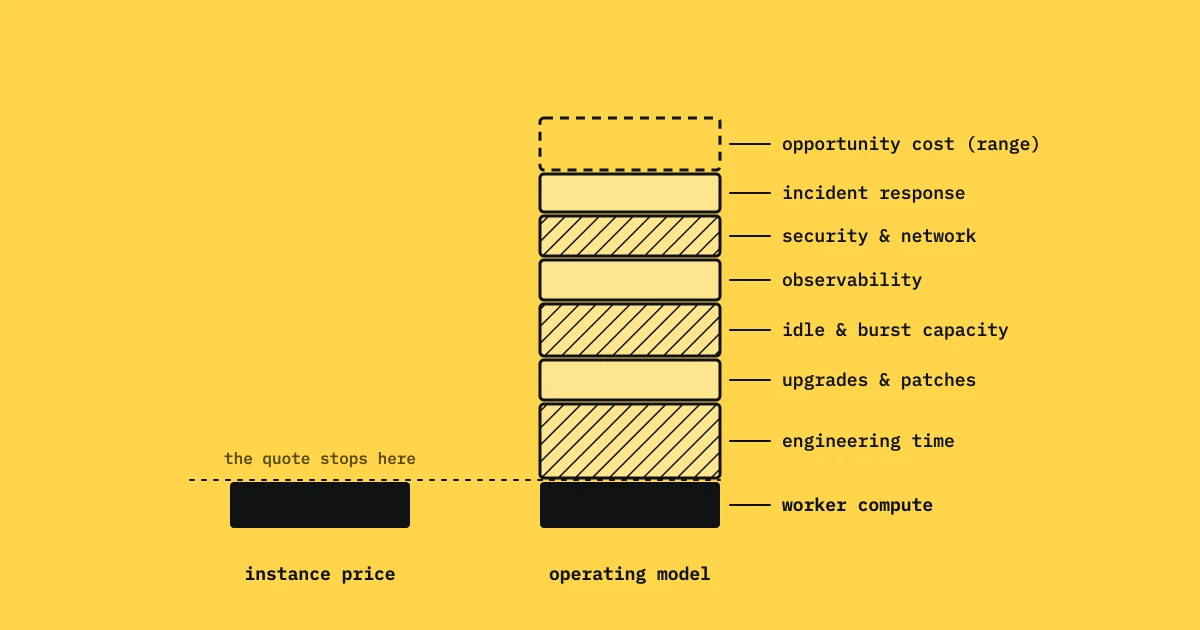
Self-hosted load testing can be the right choice when network control, data boundaries, or a well-supported internal platform matter. Its cost is more than the worker instance price. A realistic estimate includes engineering time, idle and burst capacity, runtime upgrades, observability, security, support, incident response, and the opportunity cost of maintaining a system that exists to test another system.
This post gives you a decision framework. It does not claim that managed tooling is always cheaper. Use your own workload and staffing data, and make the comparison complete enough that a low infrastructure line item cannot hide a large operating obligation.
Count the people who keep it running
Name owners for worker images, orchestration, network routes, credentials, data, result storage, dashboards, alerts, upgrades, and cleanup. Estimate recurring maintenance and the interruption cost of urgent work. Include reviews for access and target allowlists. If one specialist is the only person who can repair the path, record that continuity risk.
Separate authoring from platform operations. Engineers still need to design realistic workloads, assertions, correlation, and analysis in either model. Self-hosting adds responsibility for the machinery that makes those tests run. The distributed architecture guide lists lifecycle concerns worth assigning.
Use observed work where available. Ticket history, upgrade frequency, failed runs, and support requests are better inputs than a guessed percentage of a salary. Mark uncertain effort as a range and revisit it after a pilot.
Account for idle and burst capacity
Steady worker capacity may sit unused between scheduled runs. Burst events may require rapid provisioning, quota coordination, source addresses, storage, and extra observability. Estimate both the baseline and the peak operating shape. Do not assume a worker can appear instantly when an event is already underway.
Include the result path. Large runs can need durable storage, aggregation, retention, and export. A worker that generates traffic but cannot deliver evidence adds no useful capacity. Test partial results and cleanup, and count the storage and operator work those paths require.
If workers are shared with other workloads, include contention and scheduling. A cheap shared pool can create noisy comparisons or delay an urgent run. Isolation may add capacity cost. Without isolation, you pay in interpretation and reliability.
Include upgrades and dependency changes
Runtimes, engines, images, certificates, operating systems, libraries, and observability agents need patches. Plan validation for upgrades because a new client version can change connection reuse, timing, payloads, or result semantics. A pinned old image can reduce immediate change and increase security or compatibility exposure.
Record an exit path for each dependency. Can the team reproduce a scenario with the underlying engine? Can it export results and metadata? The JMeter refactoring guide shows why test definitions need to remain reviewable independent of the host that runs them.
Maintenance is still required when runs are infrequent. Rarely used systems can be harder to upgrade safely, because knowledge and images age between uses.
Price observability and diagnosis
Self-hosted workers need health metrics, logs, result delivery, and alerts. The target’s telemetry does not prove the generator applied the intended load. Store enough context to distinguish target failure, worker saturation, network trouble, invalid credentials, and result backpressure.
Count the time to investigate a bad run. A platform that produces a quick but ambiguous graph can create more work than one that retains operation labels, worker status, and comparable metadata. Include the cost of building and maintaining those views.
Protect diagnostics. Redact credentials and personal data, restrict access, define retention, and test deletion. Security controls require policy, tooling, and review whether the workers are in a cloud account or an internal cluster.
Include security and network work
Private targets may require routes, certificates, firewall changes, source identity, DNS, and target allowlists. Public targets need safe authorization and controls against accidental misuse. Changes can require security review and operational coordination. Put that work in the estimate.
Data residency includes request data, tokens, logs, results, backups, and support paths. A self-hosted location may simplify a boundary while increasing the team’s responsibility for access and deletion. Verify the boundary rather than assuming it from the deployment label.
Count failure and recovery work
Test worker loss, controller loss, result-pipeline slowdown, cancellation, and cleanup. Decide how partial runs are identified and whether traffic stops completely. A graceful shutdown needs implementation and rehearsal. A sentence in a runbook is not enough.
Include incident response. If the load platform sends traffic to the wrong target or leaves workers active, who detects it, stops it, and preserves evidence? Assign an on-call path and practice a bounded failure. The buyer checklist includes lifecycle and safety questions that apply to owned infrastructure too.
Compare with a complete model
Use a worksheet that separates fixed work from work that appears only during a burst or failure. List provisioning, upgrades, patching, access reviews, data preparation, generator health, result storage, alerting, and cleanup. Add the people or team responsible for each item and the evidence that shows it is complete. Then compare the worksheet with the managed or shared path under consideration, including the responsibilities that remain with the customer. Don’t turn missing data into a precise total. A range, an explicit unknown or a note that the team must measure the item is more credible than invented savings. Revisit the worksheet after a real test run. An idle generator, a manual credential step or a hard artifact retrieval can reveal work the first architecture diagram missed. You want a decision that exposes obligations before they become an incident.
Make a table with infrastructure, engineering, upgrades, observability, security, support, incident response, idle capacity, burst preparation, and opportunity cost. Add what is included or shifted in a managed alternative. Use your workload: runs per month, worker hours, locations, protocols, retention, private routing, and required response time.
Avoid universal ROI claims. A team with an established platform may have low incremental cost. A small team with rare bursts may prefer less machinery. Both can be true in different contexts. Record assumptions and test them with a representative pilot.
Self-hosting is often valuable for a specific reason. Name that reason and price it alongside the responsibilities that come with it. Count the people, lifecycle, capacity, evidence, security and recovery work, then compare the complete operating model. No single deployment shape has a universal cost.
For a concrete estimate, describe one ordinary run and one burst run from request to cleanup. List who prepares data, provisions workers, confirms target access, watches health, retrieves results, investigates an invalid run, patches the image, and deletes artifacts. Assign hours or ranges from observed work. Repeat the exercise for the alternative operating model. This comparison beats a per-hour worker quote because it includes the work needed to make that worker trustworthy.
Recalculate when run frequency, target locations, data controls, or retention changes. A system that is sensible for frequent internal runs may be a poor fit for occasional bursts, while a provider fee that looks high may replace work your team cannot staff. Write those down as assumptions, not universal conclusions.
State opportunity cost in plain language: list the product, reliability or security work that waits while the team maintains the test platform. Don’t assign a made-up dollar value if you lack data. Naming the work and its owner is enough to make the tradeoff visible for review.
