How to Refactor a JMX File Before It Becomes Unmaintainable
Refactor a JMeter JMX plan into clear variables, transactions, fragments, assertions, and reviewable diffs before load grows.
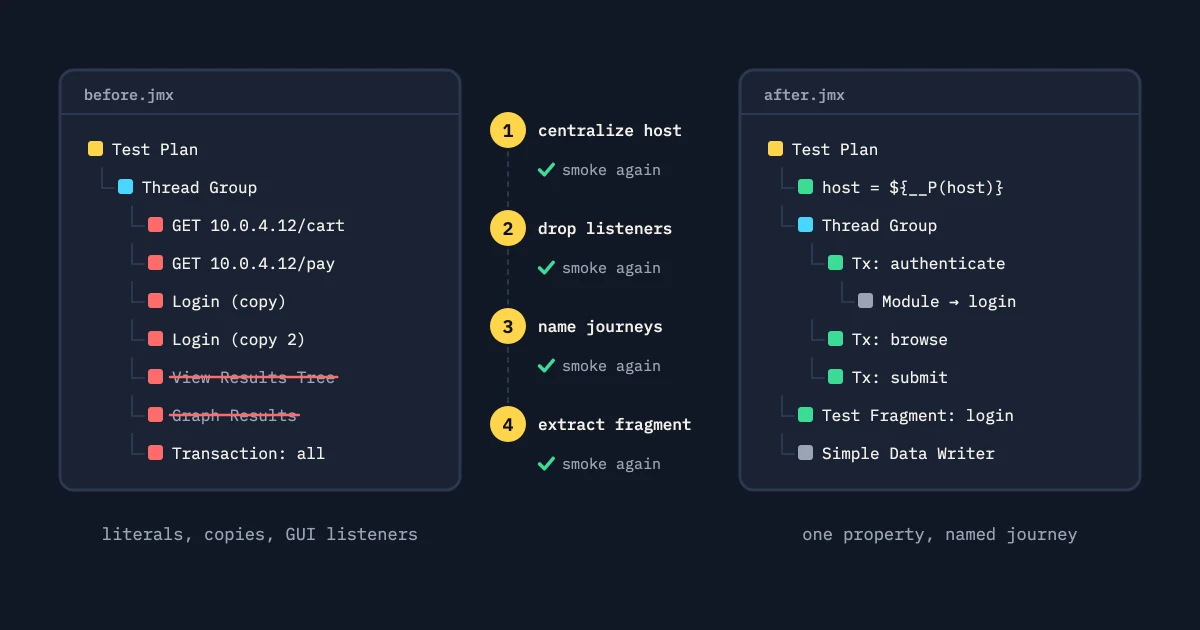
A JMX file gets hard to maintain long before it gets large enough to fail. The warning signs are familiar. The target host repeats across many samplers. Listeners stay in a load plan. Login trees are copied with slightly different headers. Nobody knows an extractor’s scope. One transaction name hides five unrelated operations. Refactoring protects the meaning of the workload and makes changes reviewable, so treat it as real work, not cosmetics.
Start with a copy of the plan and a small smoke. Keep the behavior while you improve the structure. Run the smoke before and after each meaningful change, so a cleaner tree does not quietly turn into a different test.
Establish a safe baseline
Record the current command, engine version, properties, data files, labels, assertions, ramp, duration, and output. Capture a small result for the journey. Note every listener and timer, including the ones you think are accidental. Without a baseline, a refactor can drop an important pacing or validation rule and just look faster.
Review the XML diff in version control. A large GUI save can reorder nodes or change formatting, so pair the diff with a behavior check. Ask what changed in request order, variables, headers, timers, assertions, and output, not only which lines moved.
The GUI versus non-GUI guide explains why the desktop is a workbench and not the pressure path. Use it to reproduce the baseline in a non-GUI smoke.
Centralize environment values
Move hostnames, ports, paths, users, and safe tuning values into properties or variables with clear names. Keep secrets out of the JMX file and inject them through an approved runtime mechanism. Give each central value one owner. Duplicated strings invite you to test two environments by accident.
Keep environment configuration apart from workload intent. The journey says what it does. The invocation says where it runs. Provide a safe local default only when it cannot point at a real customer system. If a required production value is missing, fail before traffic starts.
Name data files and their columns explicitly. Document whether a row is shared, consumed once, or reused by a virtual user. Changing the CSV sharing mode changes the data distribution, and with it the workload.
Reduce listener weight
Graphical listeners help when you inspect a small plan and cost a lot under load. Remove them from the pressure profile. Keep a deliberate result writer and the diagnostics the decision needs. Do not remove assertions or timers in the name of optimization. They carry workload and correctness semantics.
Review response storage too. Full bodies use memory and can leak sensitive data into artifacts. Capture only bounded, redacted diagnostics when a failure needs context. Prove behavior with assertions instead of archiving every response by default.
Group a logical journey
Use controllers to show the business path: authenticate, browse, select, and submit. Group transactions around decisions your stakeholders recognize, and keep sampler labels for diagnosis. A transaction that includes a long unrelated setup hides where the time went. A transaction for every tiny helper makes the report unreadable.
Keep loops and timers next to the behavior they describe. Set ramp and duration explicitly at the thread-group level, then state any scenario-specific pacing. A timer copied into one branch can change the request mix without showing up in a summary.
Add assertions at boundaries. Authentication should prove a usable session. Creation should prove the returned ID is valid. A final write should prove the expected state. The correlation guidance covers how to make those dependencies explicit.
Extract and reuse dynamic values
Replace pasted IDs, tokens, and cursors with narrow extractors and validate them right away. Name each variable after its source and scope. If an extractor can return an empty value, add a failure that stops the dependent path. Otherwise an empty token that produces a fast unauthorized response can distort the load result.
Limit regular expressions or parsers to the response element that owns the value. Test a changed response fixture so reviewers see the extraction failure. Hold sensitive values in memory only as long as the flow needs them, and redact them from logs.
Extract reusable fragments
Use test fragments, or an equivalent structure, for shared setup, authentication, headers, and common assertions. Give each fragment a clear contract: inputs, outputs, side effects, and labels. Avoid a giant “common” fragment that changes hidden state for every scenario. Shared code helps only while you can still see what it does.
Prefer a few focused fragments over copied trees. When shared behavior changes, run every scenario that uses it. Keep scenario-specific data and assertions at the scenario boundary, so a fragment does not claim by accident that every user journey has the same outcome.
Make the XML reviewable
Split the refactor into commits that each have one behavioral explanation: centralize properties, remove visual listeners, group transactions, or add correlation. Where you can, do not mix a full GUI re-save with a logic change. Reviewers need to spot a workload change and ask for evidence.
Keep a human-readable companion that lists the command and the intended flow. The XML stays the executable source. The companion tells a new engineer why each controller, timer, or assertion exists. Update it when the flow changes.
Re-run in the intended mode
Treat the refactor as a behavior-preserving change until evidence says otherwise. Run a small smoke with the original and revised plans against the same safe fixture, and compare request labels, assertions, extracted values, and cleanup. If you regrouped a controller, confirm that timers and configuration scope still apply to the same samplers. If you extracted a fragment, check every caller for variables it used to inherit implicitly. Keep generated output out of the review diff, and make the plan’s owner clear. A readable JMX is not automatically a correct one. The proof you want is that another engineer can understand the diff and reproduce the same behavior in the intended non-GUI mode. If the result changes, stop. Explain whether the change is a deliberate workload revision or an accidental semantic difference before you update any baseline.
After the refactor, run a clean non-GUI smoke and compare labels, request count, pacing, assertion outcomes, and generator health with the baseline. Then run the smallest meaningful load. If the result changes, find out whether the target improved or the client changed.
A refactor succeeds when the plan hides fewer decisions. Centralize values, keep data and pacing intact, remove only presentation overhead, structure logical transactions, make correlation fail loudly, and keep each diff explainable. A JMX file you can read and reproduce is a safer load artifact than one that happens to run today.
When the plan is risky, refactor in narrow steps. First reproduce the current smoke. Then centralize one property. Then remove a presentation listener. Then add one named transaction. Compare request count, timing, labels, and assertions after each change. If a difference appears, keep the old artifact and explain the difference before you go on. Maintenance then becomes a series of reversible experiments instead of one opaque XML rewrite.
Delete obsolete branches last, and only after you check their callers and result labels. An unused sampler may be noise, or it may be the only negative-path assertion in a scenario. Search the plan and its companion files, record why you removed the branch, and run the smoke with a deliberately invalid response when that branch carried protection logic. The goal is clearer behavior, not shorter XML.
