Self-Hosted vs Managed Load Testing: A Practical Decision Framework
Compare self-hosted and managed load testing by control, maintenance, data residency, burst demand, security, and operational ownership.
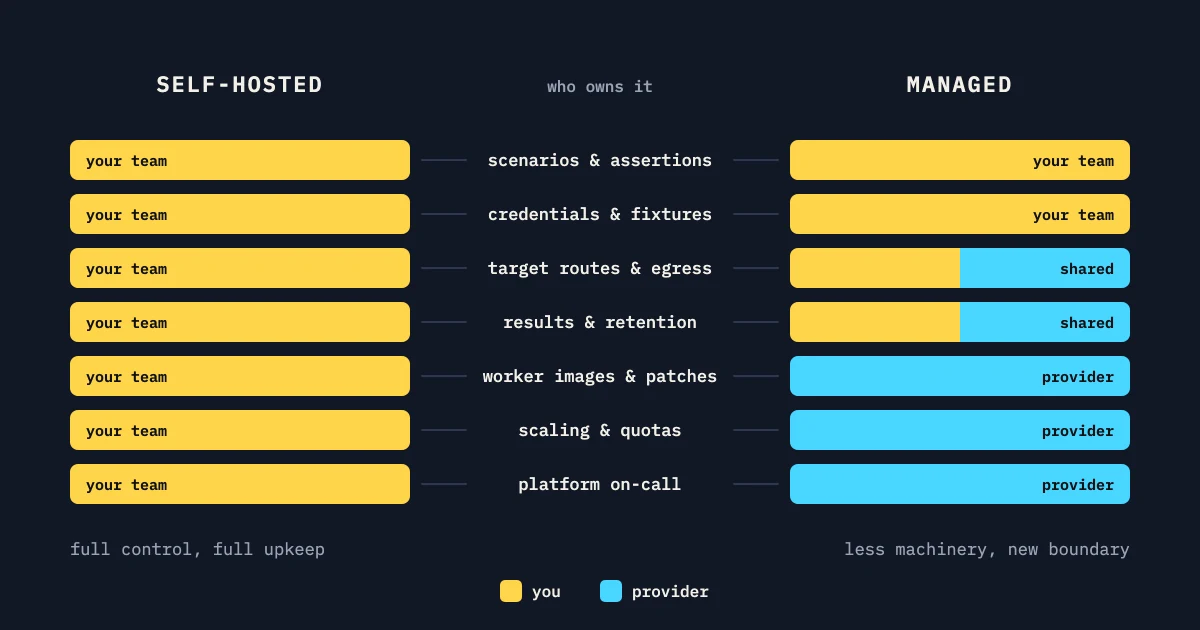
Self-hosted and managed load testing are two operating models. Neither is the virtuous choice. Self-hosting can give you direct control over network, runtime, data, and upgrades. Managed tooling can cut the work of provisioning generators, collecting results, and sharing runs. Which fits better depends on your targets, controls, demand pattern, and the people who will own failures.
Start the decision from constraints. Write down what must stay inside your network, what must repeat in CI, how often demand bursts, which protocols matter, and who responds when the test platform itself is unhealthy.
Compare control with responsibility
Self-hosting gives you control over images, placement, network routes, credentials, and retention. It also makes your team responsible for patching, capacity, observability, lifecycle, and incident response. A managed service moves some of that work to a provider, and in exchange you accept provider boundaries, contracts, limits, and a dependency on its availability.
Ask for evidence instead of assuming either model works. Check who can access artifacts, who changes worker versions, how upgrades are announced, and how a customer stops traffic. The buyer’s checklist lists a broader set of evaluation questions.
Examine network and residency
Map where targets and dependencies live. If targets are private, find out whether self-hosted workers, provider-managed private workers, or an approved bridge can reach them. Check egress, DNS, certificates, route controls, and source identity.
Data residency covers more than request bodies. Think about credentials, logs, result artifacts, telemetry, support access, and backups. Ask where each one is stored and for how long. If a managed path cannot meet a required boundary, it does not fit that workload. If a self-hosted path cannot be audited, control alone does not make it enough.
The private generation guide covers the questions at the network seam. Attach the route and location to every result, so nobody generalizes a private test into a public one.
Match the demand pattern
Steady internal testing and occasional launch bursts have different economics and operations. Self-hosted workers can be convenient when the fleet runs continuously and your team already operates the platform around it. Managed capacity can help when bursts are rare and provisioning would otherwise become a recurring project.
“Cloud” does not mean unlimited, and “self-hosted” does not mean fixed. Both models have quotas, concurrency limits, worker ceilings, connection limits, and result-path constraints. Ask for documented limits, and test cancellation, partial runs, and generator health.
Count recovery demand too. A distributed test may need extra workers to replace a failed shard, and an application may need extra capacity when clients reconnect after a fault. The distributed architecture guide explains why the test system’s own lifecycle belongs in the comparison.
Count operational ownership
For self-hosting, assign owners for images, patches, runtime upgrades, scaling, access, secrets, target allowlists, dashboards, storage, and cleanup. For managed tooling, assign owners for account configuration, policy review, scenario quality, vendor coordination, and contract limits. An item with no owner is a gap in either model.
Ask how an operator diagnoses a failed run. Can they tell target failure from worker failure, result backpressure, or an invalid credential? Can they stop all traffic and find the partial evidence? Run that exercise yourself instead of trusting a product tour.
Compare security paths
Evaluate identity, roles, audit logs, secret injection, data redaction, retention, deletion, and support access. Test a least-privilege account and a deliberately denied action. Confirm that logs and exports expose no tokens or personal data.
Self-hosting moves more security work into your environment. It does not remove it. A managed service still needs review: you have to understand its trust boundaries and contract. Your decision record should say which controls you verified and which rest on policy.
Check protocol and evidence fit
List your real scenarios: APIs, browser, GraphQL, gRPC, WebSocket, queues, dynamic data, streams, and assertions. Run one representative case in each candidate model. Compare request shape, labels, percentiles, errors, generator health, location, and artifacts.
Keep browser and protocol conclusions separate. A self-hosted API worker and a managed browser runner may answer different questions. Do not choose by the protocol that demos best.
Check portability. Can you export scenario definitions, data assumptions, thresholds, and results? Can a reviewer reproduce a failure without a hidden service setting? An exit path is worth having even when you plan no migration.
Make the decision explicit
Write the decision as a boundary map. List what your team must control directly, what it can delegate, where test traffic may come from, who owns credentials and fixtures, and which evidence must stay available after a run. Then test both options against one representative private-target scenario and one burst or scheduled scenario. Note the work each path needs to become safe, observable, and repeatable. A managed boundary may simplify routine operations and raise review questions about residency or network access. A self-hosted boundary may give you control and hand you maintenance and incident duties. Neither label answers those questions on its own. A decision record that names its assumptions can be revisited when the team, the target topology, or the compliance requirements change. That lasts longer than a choice made from ideology or a feature count.
Build a matrix with required, preferred, and irrelevant criteria. Score the evidence as verified, workaround, unsupported, or untested. Put operational effort and risk next to feature fit. If a requirement is non-negotiable, such as a private route or a retention policy, make it a gate instead of averaging it against conveniences.
Run a bounded proof: clean smoke, controlled load, invalid configuration, cancellation, and result review. Include the people who will author, operate, secure, and approve the tests. Write down what is still unknown and the experiment that would answer it.
Self-hosted versus managed comes down to control, responsibility, boundaries, demand, and evidence. Pick the model that makes your real tests safe and readable, verify the seams, and keep ownership visible. Choose the option your team can operate when the test platform itself needs attention, not only the application.
For a final comparison, run the same bounded scenario through both models if you can. Include a clean smoke, representative load, a denied configuration, cancellation, and artifact review. Compare runtime numbers, and also setup time, identity controls, diagnosis path, ownership, and recovery. Mark each difference as a fact or an assumption. That evidence gives the decision a clear scope and leaves room for a hybrid model when different targets need different boundaries.
Review the hybrid option on its merits. It is not indecision. One path may keep regulated targets inside a customer network while another uses managed workers for public release checks. Share scenario definitions and success criteria only where their assumptions match, and keep locations and artifacts separate. Let each target’s boundary and your team’s ownership pick the route, instead of forcing every test down one path.
Document the seam between the two paths: who provisions workers, where credentials live, how results are retained, and how an operator stops traffic. A hybrid model holds together when those seams are explicit and audited. It breaks when the same scenario silently changes route or owner between runs.
Put the boundary in run metadata and review templates. A later reader should be able to tell whether a result came from a provider location, a customer network, or a mixed path before comparing it with another run. That context is evidence, not paperwork.
