WebSocket Load Testing: Connections, Messages, and Long-Lived Sessions
Plan WebSocket load tests around connection storms, steady populations, message rates, fan-out, reconnects, and long-lived session state.
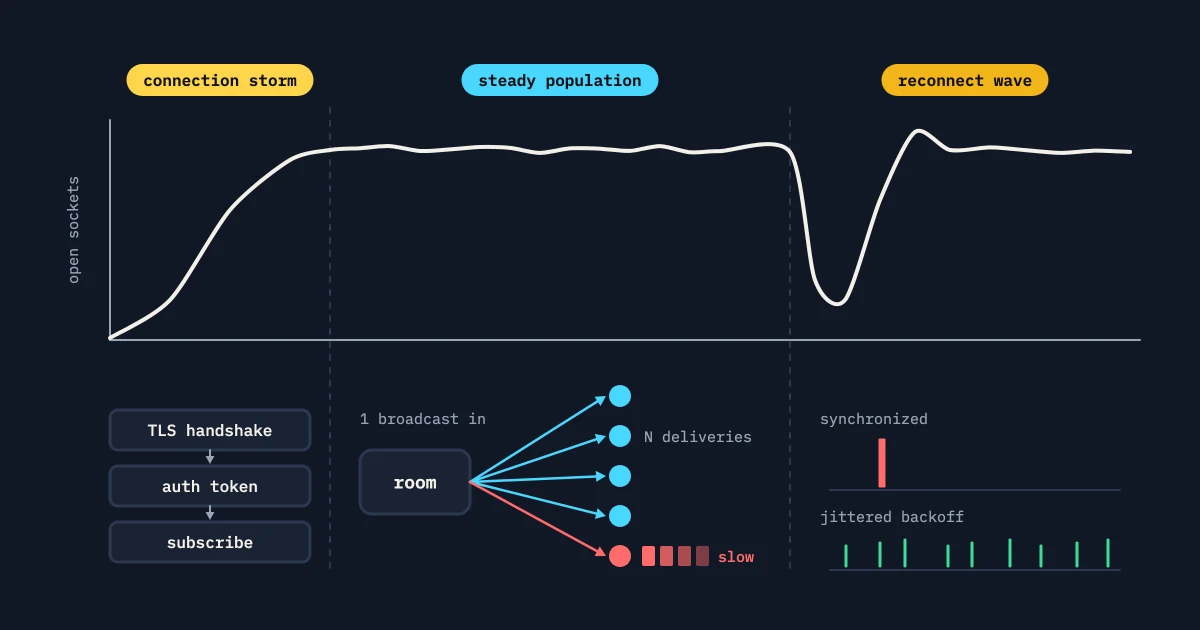
WebSocket load is a population problem as much as a request problem. A system can handle a steady set of quiet connections and fail when many clients connect at once. It can accept connections and fall behind on message fan-out. It can sustain messages through a short run and leak state over a long session. A useful test separates those behaviors instead of reporting one connection count.
Start by describing the session lifecycle: connect, authenticate, subscribe, send or receive messages, change state, disconnect, and reconnect. Then decide which parts are steady, which are bursts, and which the user drives. The result should say whether it tested connection capacity, message throughput, fan-out, or recovery.
Test the connection storm separately
A connection-storm scenario exercises TLS, authentication, accept queues, handshake work, session allocation, and subscription setup. Ramp connections at a stated rate, and record handshake latency, rejection classes, established count, and server resource use. A connection rejected during an intentional ceiling test is not an unexpected application failure, so keep the two apart.
Use realistic connection reuse and authentication. A test that skips the token path may leave out expensive work. A test that logs every client in at the same instant may create a synchronization event your customers never produce. State your choice, and run a separate burst scenario if synchronized arrival is a real concern.
After the storm, hold a stable population. A server that survives the handshake but slowly loses sessions needs a different investigation from one that cannot accept the first burst.
Measure messages and fan-out
Label message types, sender role, recipient scope, and payload size. Measure send acceptance, receive delay, delivery count, duplicate count, and dropped or rejected messages. For broadcasts, count separately the one message the server accepts and the deliveries it creates. Fan-out can multiply work even when the incoming message rate is modest.
Use a bounded distribution of message rates and subscriber counts. A quiet presence update, a room broadcast, and a private notification cost different resources. Include the mix your product creates, and add a focused high-fan-out case only when the architecture has to support one.
The real-time testing material helps frame session and network behavior. Keep application semantics in the scenario: a socket that stayed open does not prove a message arrived.
Preserve state transitions
Many WebSocket bugs appear after a state change. A client subscribes to a room, changes permissions, leaves, or reconnects with a new token. Test those transitions with assertions that prove the old subscription is gone and the new one applies. A connection count cannot reveal a stale subscription leaking messages.
Generate IDs and tokens as dependencies. If a setup API creates a room, carry its identifier into the socket scenario and validate it. If a reconnect has to resume a session, assert what the product promises: replay, a clean resubscription, or a deliberate reset. The correlation guide applies to these multi-step values as much as to HTTP.
Keep fixtures bounded and cleanup explicit. Long-lived tests can leave state that affects later runs. Use namespaces and safe teardown, and record incomplete cleanup instead of quietly reusing stale subscriptions.
Exercise slow and disconnected peers
Backpressure shows up when one client reads slowly or stops reading. Watch whether the server queues, drops, closes, or applies a per-client limit. Measure memory and queue depth where you can. A test with only fast consumers can miss an unbounded buffer that later takes down the process.
Close connections at controlled rates and watch cleanup. A reconnect storm can overload authentication and subscription services after the socket layer has recovered. Add a randomized, bounded reconnect delay if the real client does that, and run a synchronized reconnect case separately when a deployment or network event could cause one.
Label expected policy responses clearly. A connection closed by an idle timeout may be correct. A close caused by an exhausted worker pool is not. Report the close code, reason class, and lifecycle phase without logging secrets or full user payloads.
Observe the whole path
Collect connection count, handshake rate, message ingress and egress, per-type latency, fan-out, queue age, CPU, memory, event-loop or worker pressure, and network usage. Join these signals with scenario and session phase. A global message average can hide one room whose subscribers get late or duplicate events.
Watch the generator’s socket and file-descriptor limits. A worker that cannot hold its intended population changes the offered load. In distributed execution, include worker health and aggregation context so nobody mistakes a missing shard for a quiet target.
Define useful success criteria
Describe a WebSocket run as a lifecycle, not a request counter. A connection can be accepted and fail to subscribe, receive an initial state and miss later messages, or reconnect without restoring the intended session. Give each phase a label and an assertion: handshake, authentication, subscription, steady-state delivery, reconnect, and close. Record message sizes and fan-out assumptions, because they change both bandwidth and application work. Keep connection churn in its own scenario so it does not blur the behavior of a stable population. When a client disconnects, record whether the server closed it, the network ended it, or the test reached its planned stop. These distinctions help an owner choose between admission controls, broker capacity, serialization work, and client backoff. They also keep a long-lived test reviewable when its last sample arrives long after its first connection.
A steady-session gate might require an established population, bounded disconnects, complete message delivery, and a tail delay budget. A connection-storm test might focus on acceptance and recovery time. A fan-out test might require no duplicates or drops under a named subscriber mix. Keep those rules separate so one green result does not claim more than it tested.
Compare runs only when session duration, data, message mix, client pacing, and connection strategy match. Comparing load-test runs explains why a changed population or cache state weakens a conclusion.
WebSocket load testing needs a timeline. Test the storm, the steady population, message fan-out, state transitions, slow peers, and reconnect behavior as named scenarios. Measure both connection and message outcomes, keep the generator healthy, and make lifecycle assertions visible. That evidence tells your team whether the limit sits in acceptance, delivery, state, or recovery.
As a review example, a run may show that every client connects but one broadcast room gets messages late once its subscriber count rises. Keep the room mix, compare ingress with delivery, inspect per-client queue behavior, and repeat with a bounded group of slow consumers. That sequence separates fan-out work from connection acceptance and hands the owner a smaller next test. A connection-count chart alone would miss the delay customers see.
End each run by checking cleanup. Confirm that subscriptions, timers, buffers, and authentication state are released after disconnect. Compare process memory and active session counts before and after a repeated lifecycle. A long-lived protocol test that measures only the happy path, and leaves the system in a state that changes the next run, is incomplete.
Write the session assumptions next to the result: authentication method, subscription mix, expected message cadence, reconnect policy, and peer pacing. When your team changes any one of those inputs, start a new comparison instead of attaching the result to an old baseline. A healthy connection test then cannot pass as evidence about a different real-time workload.
Record close outcomes by lifecycle phase so setup failures do not vanish into steady-state disconnects. A release review can then ask whether the problem lies in admission, delivery, state, or teardown. Each calls for a different fix and a different follow-up run.
