gRPC Load Testing: Streams, Deadlines, and Backpressure
Design gRPC load tests that distinguish unary calls from streams and expose status codes, deadlines, message size, reuse, and backpressure.
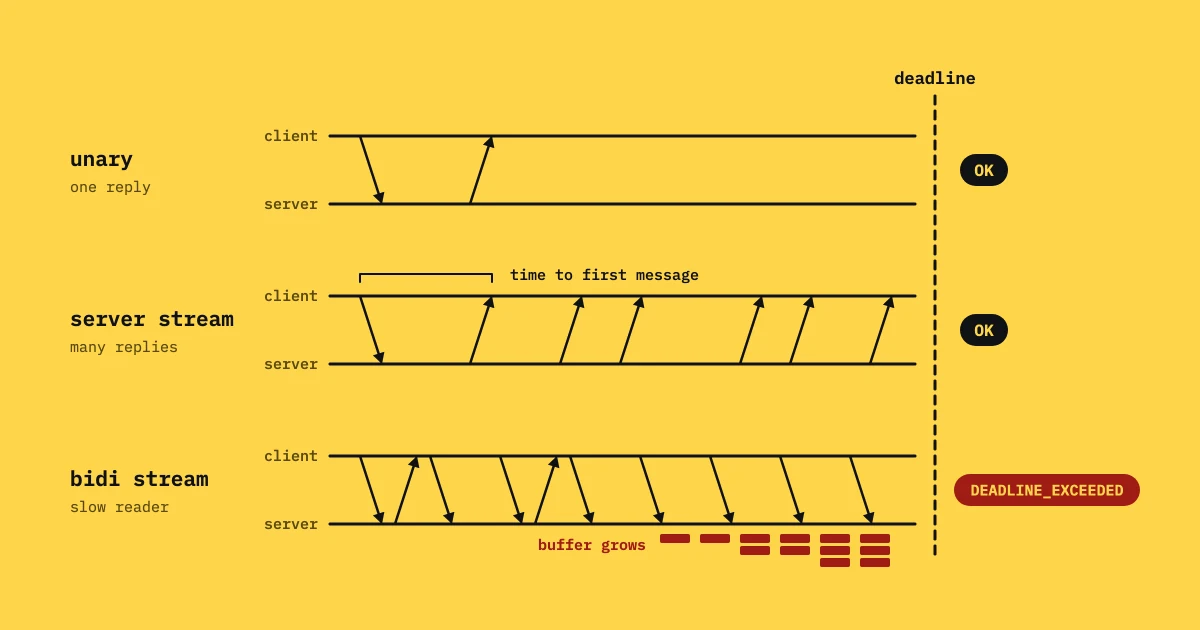
gRPC load testing needs a different vocabulary from simple request counting. A unary call has one request and one response. A server stream can keep a connection open while messages arrive. A bidirectional stream has two independent flows whose timing and backpressure interact. The same service can look healthy under unary pressure and fail when long-lived streams occupy connections or buffers.
Start with the contract your clients use. Identify methods, message sizes, metadata, deadlines, stream duration, expected message cadence, and the behavior when a peer is slow. Then build scenarios that preserve those properties and report method and stream labels separately.
Separate call shapes
Unary scenarios should measure request latency, status, payload size, and concurrency. Include realistic metadata and authentication, but do not let setup dominate the method under test. A warm channel and a channel created for every call answer different questions, so name your choice.
For server streaming, measure time to first message, inter-message delay, completion time, cancellation, and total messages. A stream that delivers its first item quickly and then stalls is not a healthy stream. For client streaming, verify that the server handles slow or uneven message arrival without unbounded memory growth.
Bidirectional streaming requires labels for both directions. One side may continue sending while the other is blocked. Record send and receive outcomes independently, then report whether a stream ended by completion, cancellation, deadline, or transport failure.
Treat deadlines as a budget
Deadlines are part of the client contract. Set them deliberately, and record whether a deadline is local to one call or propagated across downstream calls. A test that leaves out deadlines can keep work running after the client has given up, and the result is kinder to the service than real traffic.
Test near the deadline boundary with a controlled dependency delay. Confirm that the client receives the expected status, the server cancels work where supported, and retries do not replay non-idempotent operations. A deadline failure should be distinguishable from an unavailable transport or an application rejection.
If a chain of services shares one deadline, observe remaining budget at each hop. A fast first hop can consume little time while a later dependency receives almost none. Measure hop-level latency and final status together. The top-level percentile alone cannot explain where the budget went.
Exercise message size honestly
Payload size affects serialization, compression, memory, network transfer, and downstream parsing. Use a distribution that resembles the client population, including a bounded large case if the API permits it. Don’t make the largest valid message your only scenario, because it can hide the common path.
Assert message count and key invariants without storing every payload. If compression is enabled, record whether the test uses it. Compare like with like when evaluating a change: a compressed candidate and an uncompressed baseline are two different workloads.
Test configured message limits as explicit boundary cases. An expected rejection proves the guard is reachable. It is not evidence of capacity failure. Keep boundary tests separate from sustained traffic so operators can tell protection behavior from overload.
Observe channel reuse and connection pressure
Channels and connections have lifecycle costs. Reusing a channel may represent a normal client and may expose stream multiplexing behavior. Creating new channels at a high rate may represent a connection-storm scenario. Measure both only when both are real risks, and label them distinctly.
Watch file descriptors, connection counts, TLS work, client CPU, server accept queues, and per-channel stream limits. A saturated generator can fail to open intended streams and make the target appear quiet. Include worker health in the result and stop a run whose driver no longer applies the requested shape.
Connection reuse also changes failure recovery. Close a channel or interrupt a network path in a controlled resilience test, then observe reconnect delay, in-flight call behavior, and retry load. A reconnect storm can be more damaging than the original fault if every client retries together.
Make backpressure visible
Backpressure is a correctness and capacity signal. Create a consumer that reads at a stated pace and see whether the producer blocks, buffers, drops, or receives an error. Measure queue or buffer depth where exposed. A stream that “handles” pressure by piling up memory is only postponing failure.
For a bidirectional method, vary send and receive rates independently. Test a healthy peer, a slow peer, and a disconnected peer. Verify cancellation and cleanup after each case. Keep fault injection controlled and authorized. You want to learn the contract, not create an unbounded flood.
Choose gRPC-specific success criteria
Write the lifecycle assertions before choosing a target rate. For unary calls, check status, deadline handling, message validity, and any required metadata. For streams, assert connection establishment, expected message counts or terminal conditions, flow-control behavior, and the final status. Keep cancellations and server closes in separate result classes so a graceful end does not resemble a fault. A smoke with one stream and a small message sequence can validate the contract before a longer connected-population test explores resource use. When a run fails, correlate client-side deadlines with server logs and transport metrics. A client timeout alone does not tell you if work continued downstream. Framed this way, gRPC results are useful to both the service owner and the test author, and a high request rate cannot mask a stream that never completed its application-level contract.
A useful gate can include method latency, time to first message, completed stream ratio, status-code classes, deadline cancellations, message invariants, and generator health. Add dependency saturation and retry volume when they affect the decision. Don’t reduce every outcome to “HTTP success”. The meaning lives in gRPC status and stream lifecycle.
The multi-region distributed-load guide helps when streams run across several workers. Preserve clock context and aggregate stream duration carefully. A long-lived population can make sample counts look small while it holds a lot of resources.
For example, a notification service may pass a unary lookup while its streaming subscription accumulates delayed messages. A useful follow-up keeps the lookup as a control, holds the connected population steady, slows a bounded set of consumers, and compares time to first message, inter-message delay, buffer behavior, and cancellation. That experiment tells you more than a higher unary request rate, because it keeps the lifecycle in which users actually see the defect.
Before a release, review method names, status expectations, deadline propagation, message limits, channel strategy, and cleanup. Confirm that a deliberately invalid call is classified as an expected guard response and that a valid call cannot be hidden by a transport-only success metric. With this checklist, engineers who did not write the client can read a protocol result.
Keep stream duration explicit in the report. A short connection lifetime measures setup and teardown. A long steady population measures retained resources and delivery over time. Don’t report one as the other. Keeping them apart also makes capacity planning more honest when a few streams hold resources for a long time.
Include the stream’s final status and reason in every aggregate. A connection still open at test end differs from one that completed its contract, and a deadline cancellation differs from a server close. With lifecycle detail, an operator can choose the next experiment. Without it, every abnormal end collapses into one error count, and the team argues about whether the server, the network, or the client deadline was at fault.
