Reddit's Pi Day 2023 Outage: What a K8s Upgrade Broke
Reddit's March 14, 2023 Pi Day outage lasted 314 minutes after a Kubernetes 1.24 upgrade. What the postmortem says and how to rehearse upgrades.
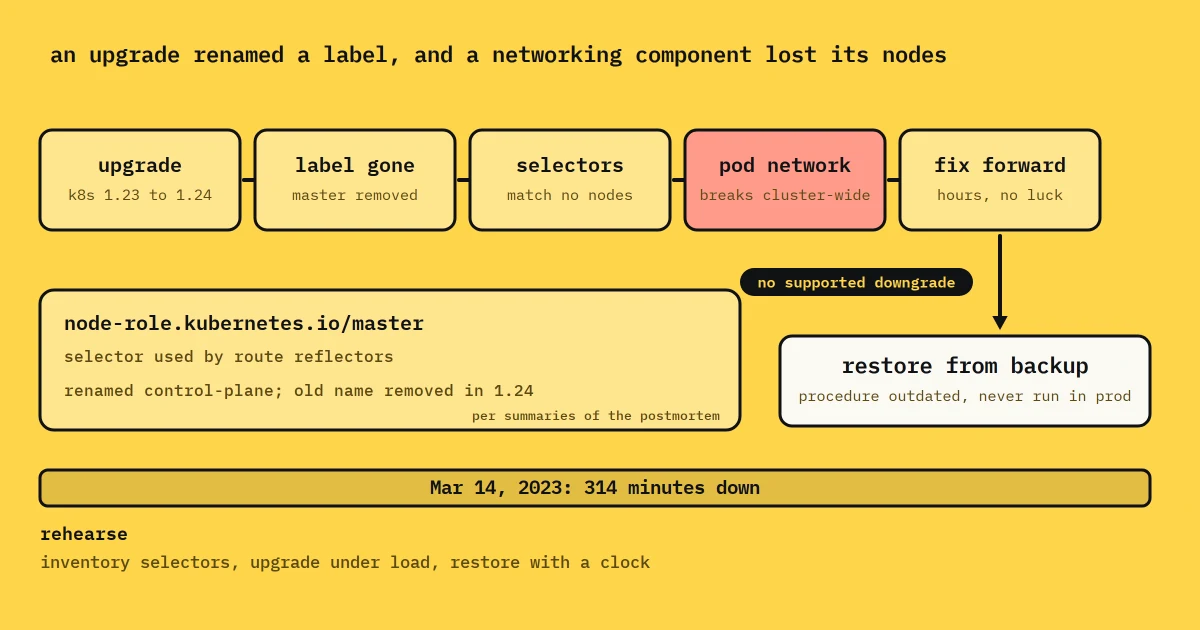
On March 14, 2023, Reddit went down for 314 minutes, close to five hours, during a Kubernetes upgrade from 1.23 to 1.24 on one of its most important clusters. Reddit’s engineers wrote it up in You Broke Reddit: The Pi-Day Outage on r/RedditEng. The cause was not the upgrade alone. A label change between releases broke a networking component nobody had written down, and the way back was a restore nobody had practiced.
Sources: the details below follow two published summaries of Reddit’s post, The Pragmatic Engineer’s newsletter and David Young’s post-mortem summary. Check anything you plan to quote against Reddit’s post.
What caused the Reddit Pi Day outage
Per those summaries, Reddit was upgrading a large, older cluster that ran its legacy stack. An engineer started the upgrade shortly after 19:00 UTC. The cluster looked fine for about two minutes, then failed. Responders were on a call within minutes.
The proximate cause, as summarized, was a renamed Kubernetes node label. Kubernetes had moved from the master label to control-plane, and the version 1.24 upgrade removed the old name. On Reddit’s largest legacy clusters, route reflectors for the cluster networking layer picked their nodes with selectors that used the old label. After the upgrade the selectors matched nothing, and pod networking broke. The summaries add that the route reflector configuration had never been committed to a shared record, so few people knew it existed, and that an engineer remembered it during the investigation.
Reddit’s own framing, according to the Pragmatic Engineer, is that the label change was a symptom. Years of organic growth had left nearly every critical cluster customized in its own way, and Reddit’s Compute team is working to standardize them.
What the recovery looked like
The summaries describe this sequence:
- The team spent an hour or two trying to fix the cluster live, including restarting services and attempting a forward fix. Nothing worked.
- Rolling back was not an option. The write-ups quote Reddit saying Kubernetes has no supported downgrade procedure, so going back meant restoring the cluster from backup.
- The restore procedure was out of date and had never been run against a production cluster. It had been written for Docker and an older Kubernetes version, and the team rewrote parts of it live. Initial estimates were on the order of hours.
- Because the cluster was already down, the team took the chance to delete its admission webhook configurations. API server write timeouts in webhook calls had shown up as an early symptom.
- The team completed the restore and service returned after 314 minutes.
Neither summary gives a minute-by-minute recovery log, and this article does not invent one.
What this outage teaches about upgrade testing
The failure had three layers, and each needs a different test.
The upgrade changed something implicit. A label name is not an API most teams review, yet something depended on it. Tests that only check your own manifests will miss it.
The staging path did not match the production path. Reddit’s rollout, per Young’s summary, went through test clusters first, then production from lowest to highest criticality. The summaries do not claim the test clusters were wrong in every way, but a component that exists only on the oldest, largest clusters stays untested on newer ones.
The rollback was untested. A restore that has not been run is a hypothesis.
Rehearse the upgrade on a cluster that looks like production
A rehearsal is only as good as the cluster it runs on. Build or clone a cluster that matches production in four ways: Kubernetes version history, add-ons and their configuration, custom controllers and webhooks, and node labels and taints. If the production cluster has been upgraded in place for years, the rehearsal cluster needs the same history. A freshly built cluster at the same version differs in exactly the places that matter.
Before the rehearsal, inventory what selects on what. List every selector, affinity rule, nodeSelector and label match across your manifests and operators. Diff the labels and APIs that change or disappear between the two versions against that list. Do this as a script, so it runs before every upgrade.
Run load through the upgrade
An upgrade changes how a live system behaves, so test it while it is carrying traffic.
- Start a steady, representative workload against a service on the cluster, from outside the cluster.
- Run the upgrade steps, one at a time, in the rehearsal environment.
- Record error rate, p95 latency, request throughput, pod restarts, DNS resolution time and cross-node connection failures at each step.
- Mark the exact second each upgrade step starts, so a break lines up with a cause.
Per the summaries, Reddit’s cluster failed about two minutes after the upgrade began, so there was little warning. A tight metric interval (seconds, not minutes) makes the difference between seeing the cliff and seeing its aftermath. For related guidance on load behavior during cluster changes, see Kubernetes HPA load testing, which covers how scaling interacts with load.
Test the rollback and the restore, with a clock
Treat the way back as a feature with its own acceptance test.
- Decide the rollback path for each upgrade step in advance. If the answer is “restore from backup”, say so in the plan.
- In the rehearsal environment, take a backup, break the cluster on purpose, and restore it.
- Time the restore from the decision to the first healthy user journey. Reddit’s initial estimate was hours, and an estimate with no rehearsal behind it will be wrong in either direction.
- Run the restore from the written runbook, by someone who did not write it. Every step that needs a live rewrite is a runbook defect.
- Check the restored cluster under load. A restored cluster with empty caches and reconnecting clients is its own surge, the same recovery shape described in the Roblox 2021 postmortem analysis.
- Repeat after each major version, because the procedure ages.
Also test your emergency levers. If a fail-open admission webhook policy lets the API server keep working when a webhook is unreachable, prove it works. A test that blocks the webhook endpoint and then tries to create a pod takes a few minutes to write.
Use chaos experiments for the networking layer
A rehearsal covers the planned path. To find the next undocumented dependency, break the networking layer deliberately while a load runs: remove a label from a subset of nodes, take down a route reflector or its equivalent in your CNI, and watch what degrades. Chaos experiments under load describes how to scope these safely, with a short duration, an abort condition and a named owner.
Run these in an environment you are authorized to disrupt. Record what the pods saw, what the control plane saw and how long it took your team to find the cause. If the diagnosis depends on one person remembering something, that is a finding.
Rehearsal checklist
- Inventory every selector and label dependency, and diff it against the target version’s removed and renamed labels.
- Build a rehearsal cluster that shares production’s upgrade history and add-ons.
- Start representative load from outside the cluster.
- Run the upgrade step by step, with metrics at one-second to ten-second resolution, and stop at the first regression.
- Break and restore the cluster, with a clock and a runbook someone else wrote.
- Replay the first-hour recovery under load, and measure the time to the first healthy journey.
- Fix what the rehearsal found, commit the configuration that was living in someone’s memory, and run it again.
Keep the source separate from your own measurements. What Reddit’s postmortem says about 2023 belongs next to its link. Your rehearsal numbers belong in your own report.
Questions this article answers
What caused the Reddit outage on March 14, 2023?
Reddit was upgrading a critical Kubernetes cluster from 1.23 to 1.24 when the cluster failed. Summaries of Reddit's postmortem trace it to a node label that changed between releases, which broke a component that selected nodes by the old label name.
How long was Reddit down on Pi Day 2023?
314 minutes, close to five hours, according to Reddit's postmortem as reported by the sources linked in this article. The upgrade started shortly after 19:00 UTC.
Why did Reddit restore from backup instead of rolling back?
Summaries of Reddit's post say Kubernetes has no supported downgrade procedure, so going back meant restoring the cluster from backup. The team had not done a restore like that in production before, and the written procedure was out of date.
How should teams test a Kubernetes upgrade?
Rehearse it on a cluster that matches production in age, add-ons and custom configuration, run representative load through the upgrade, check for renamed or removed labels and APIs beforehand, and time a real restore from backup.
