Roblox’s 2021 Outage: Why Recovery and Cache Warming Matter
Roblox's own postmortem shows why recovery, dependency failure, restart behavior, and cache warming belong in resilience tests.
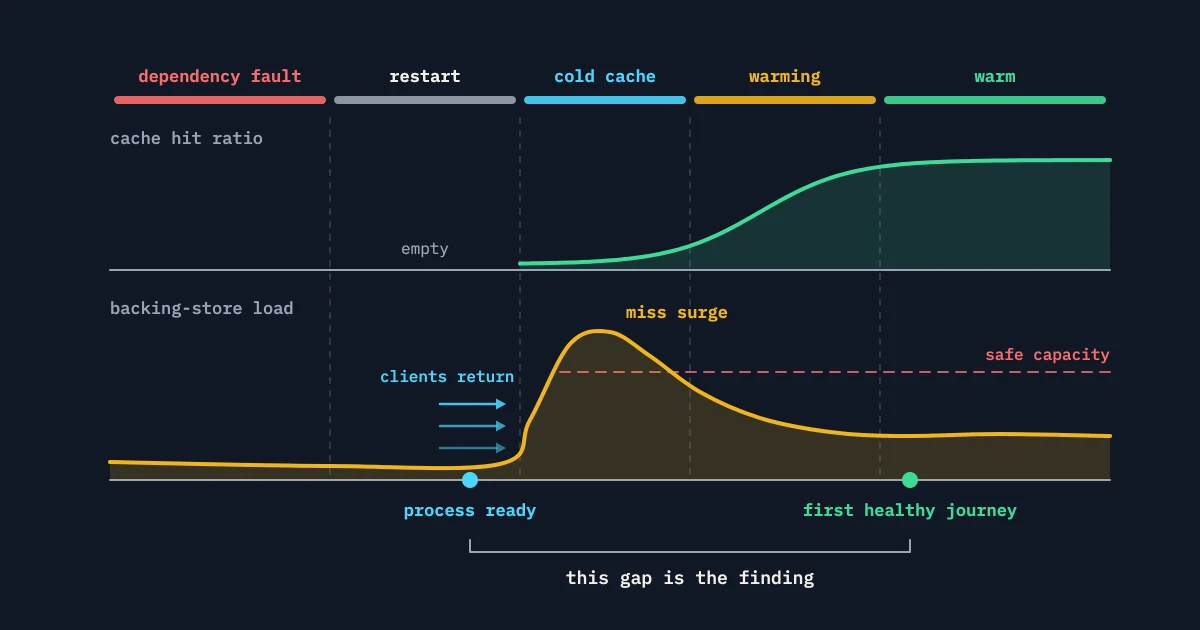
Roblox’s 2021 outage teaches a useful resilience lesson because the company published a detailed Return to Service postmortem. The postmortem describes a chain of failure and recovery work. It does not say a promotion’s traffic caused the outage. For testing, the lesson is to exercise recovery and cold-state behavior instead of repeating an unsupported causal headline.
Keep the account faithful
Roblox describes an incident that began October 28, 2021 and lasted through October 31, involving the company’s self-managed on-premises Consul cluster and a complex recovery. The postmortem says the root cause included excessive contention under Consul’s streaming feature at unusually high read and write load, plus a pathological performance issue in Consul’s BoltDB persistence path. It also says a spike in external traffic did not cause the outage. This article takes those material facts from that account and adds no private root cause.
The distinction matters to performance teams. A team that misremembers the cause as “too much traffic” may run only a larger spike test. The published narrative points to dependency behavior, recovery sequencing, and the work needed to restore service.
Recovery is a workload
Recovery from an outage can create a load shape unlike the original incident. Clients reconnect, operators restart services, queues drain, caches refill, and background jobs resume. When all of that happens at once, the recovery path can overload a system that survived ordinary demand.
Test the sequence in an environment you are authorized to disrupt: dependency degradation, partial restart, traffic restoration, and queue drain. Measure time to healthy service, error rate, accepted versus completed work, and the point where caches and pools settle.
Cold caches change behavior
A warm cache can make a service look ready. After a restart or eviction, the same requests may hit storage or a remote dependency. When many clients return at once, cache misses can create a second surge. Include cold, warming, and warm steady-state phases in the scenario, and label them.
Do not assume cache warming always helps. A prewarm job can compete with customer traffic or hammer a hot key. Test its rate, priority, failure behavior, and stop path. Check that a missing cache entry does not turn into an unbounded retry.
Preserve dependency boundaries
If a self-managed Consul cluster or another shared service is part of your failure hypothesis, pick the right fidelity. A deterministic substitute tests your retry and fallback logic. It cannot prove the real cluster’s contention, quota, or latency. A real dependency needs approval, rate limits, synthetic data, and a clear abort path.
Record timeout, retry, backoff, and jitter behavior. A client that retries instantly during recovery can turn a partial failure into a sustained wave. A client that gives up for good may cut load while losing useful work. Report both behaviors in the result.
Test restart semantics
Restart one component at a time. Then, if the architecture requires it, test a controlled broader restart. Watch connection re-establishment, session validity, queue ownership, duplicate delivery, idempotency, and readiness probes. “The process is up” does not mean “the journey is ready.”
Run one actor through recovery, then a small cohort, then the planned arrival shape. Keep a browser cohort if user-visible recovery matters, but separate it from protocol scale. The spike test and soak test answer different parts of the sequence.
Define recovery success
Set a time-to-recover objective, a maximum error window, a queue-drain condition, and, where it applies, a no-lost-work assertion. Mark the run invalid if an unplanned dependency or operator action changes the scenario. Capture the timeline and the decisions each owner made.
Keep the staged workload and result so you can repeat recovery tests. The Roblox postmortem’s lasting lesson is broader than staying up under steady traffic. Resilience means returning safely when dependencies, processes, caches, and clients all change state.
A recovery timeline to rehearse
At time zero, introduce the approved dependency fault and watch the fallback. Restart the affected component and check readiness with a real journey. Restore dependency access, release a small queue batch, and raise traffic in controlled steps. At each point, record errors, queue age, cache hit rate, connection re-establishment, duplicate work, and successful business completion.
If recovery works only while traffic stays low, document that as a capacity boundary. If cache warming eats worker capacity, throttle or prioritize it. If clients reconnect in sync, add backoff and jitter to the client scenario. Test the recovery mechanisms your own service owns instead of replaying unsupported claims about Roblox.
In review notes, put the incident source next to every material statement. Keep what the Roblox postmortem reports apart from what your resilience experiment infers. That stops the lesson from becoming a simplified outage myth and keeps the test on mechanisms your team can change.
The recovery report should name the first healthy journey, not only process readiness. Record when dependencies became reachable, caches settled, queues stopped growing, and users completed the business flow. If those timestamps differ, the gap is a resilience finding.
Treat cache warming as a hypothesis
The Roblox source gives historical context for asking how your system behaves when demand returns after an interruption. It does not give you a complete topology or a license to reproduce customer traffic. Use synthetic keys and a bounded cohort. Write down whether the experiment tests cold-cache latency, cache-fill pressure, dependency recovery, or how they interact. Each question needs its own evidence and abort condition.
Start with a cold control and a warm control. In the cold case, check that misses are expected and that the backing store can serve the fill rate. In the warm case, confirm the key distribution and expiry policy instead of assuming a cache hit. If the warm result is fast only because every worker requests one popular key, the scenario does not represent a broad catalog. Record cardinality, object size, hit ratio, and eviction signals alongside latency.
Model recovery in stages. Stop a synthetic dependency or add a bounded delay, watch retries and queue growth, then restore it and measure time to useful completion. An application that answers quickly while retrying in the background can still overload the dependency after recovery. Add a retry budget and assert that no duplicate writes or duplicate notifications occur. Keep the impairment short and reversible, with an operator authorized to abort.
Separate customer-visible readiness from process readiness. A pod can be healthy while caches are empty, queues grow, or a feature path returns a fallback. Define the first acceptable business journey and the signals that prove it. Watch origin load, connection pools, memory, and cache churn during warm-up. A recovery that never reaches steady state does not pass.
Afterward, reset synthetic state and confirm the next run starts under the intended condition. Keep the historical source link, your assumptions, and the exact recovery timeline. What you want is a repeatable resilience experiment with honest limits, not a fabricated replay of an incident.
Compare the recovery timeline with a no-impairment control. If the control also shows queue growth, the fixture or workload may be wrong. If only recovery shows it, look at retry amplification, cache stampedes, and admission policy before you change capacity. Keep those hypotheses separate in the final decision record.
Keep the historical account and the experiment record apart. The source supports the reason to test recovery. Your synthetic key space, impairment duration, traffic ceiling, and success criteria are local assumptions, and each needs its own review.