Performance Testing in CI/CD: PR, Nightly, and Release-Test Cadence
Build a performance-testing cadence with a small PR guard, a broader nightly run, and representative release evidence.
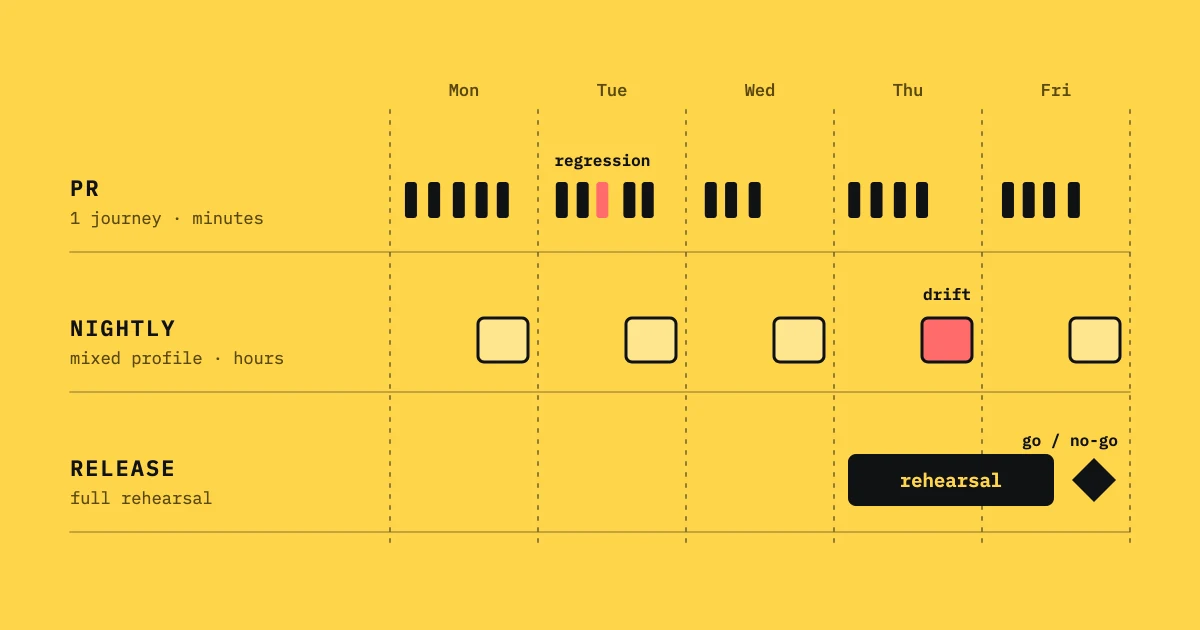
Performance testing in CI/CD works when each layer has a clear cost and a clear decision. A pull-request check should be small and repeatable. A nightly run can explore wider variation. A release test should represent the risk of shipping. If one test tries to do all three jobs, every layer gets expensive and nobody trusts it.
The PR layer
Keep the pull-request guard narrow: one critical journey, modest load, short duration, stable data, and explicit assertions. Its job is to catch an obvious regression inside a controlled boundary. It does not prove peak capacity. Check that the generator hit its target, so a fast but underloaded run cannot pass by accident.
Use a comparative or tightly bounded threshold. Environment noise is real, and people retry a gate that fails at random until they stop paying attention to it. When the gate fails, report the journey, signal, baseline, workload, and validity. Keep the artifact for diagnosis.
The nightly layer
Nightly runs can cover more journeys, longer holds, different data distributions, and a wider arrival shape. Compare them with a known baseline and look at trends. Do not make every change block a merge. Use nightly runs to find slow drift, cache behavior, pool exhaustion, and resource leaks.
A nightly test needs an owner. Record the environment version, dependencies, generator locations, test data, and alert routing. A red result with no triage path is just decoration on a dashboard.
The release layer
Run a representative rehearsal for release candidates and planned events. Keep the topology, network placement, queues, quotas, and dependency behavior that matter in production. Define the forecast, safety multiplier, cache state, duration, recovery test, and abort path before the window opens.
Do not use the release run as an oversized PR gate. It can take longer and may need approved staging or a production canary. Its result should support a decision with explicit limits. It is not a universal claim that the system can handle any future load.
Keep the layers connected
Use the same journey names, labels, assertions, and result vocabulary where you can. A failed PR journey should map to the matching nightly and release evidence. If the workload differs, label the difference clearly. Do not compare a warm one-minute smoke with a cold two-hour rehearsal as if the charts were interchangeable.
The CI/CD performance gates use case gives context for release decisions. Performance thresholds covers how to derive criteria from consequences and observed variance.
Make tests deterministic enough
Control what you own: versions, data allocation, arrival schedule, environment, cache preparation, generator capacity, and measurement windows. Do not promise perfect repeatability for a distributed system. When ordinary variance overlaps the threshold, use repeated evidence or a review state.
Keep invalid runs apart from product failures. Exhausted data, a missed rate, a broken target, and a deployment change each need a different outcome. If a gate treats every red result the same, engineers learn to ignore the gate.
Organize ownership
Developers should own the performance impact of their changes. Platform teams should provide safe execution and telemetry. QA or performance specialists can maintain scenarios and question assumptions. The cadence belongs to the whole team, not to one specialist.
Keep test artifacts and historical results together for each layer. Where you store them matters less than matching each test’s size to its decision: fast signal for a local change, broad signal for drift, and representative evidence for a release.
Keep CI from teaching bad habits
Give every failure a category and a next action. A product regression should link to the journey and the comparison. Environment drift should page its owner. An invalid generator run should be rerun after the worker is fixed. An intentional threshold change should be reviewed as a policy change. Do not let automatic retries turn a red performance result into a green check nobody can explain.
A weekly review can remove flaky checks, refresh fixtures, and compare nightly trends with release evidence. If a PR test keeps failing on environmental noise, narrow its scope or move the question to nightly. Do not weaken the assertion until it says nothing. The cadence is healthy when engineers trust what each layer means.
Keep an ownership map: who maintains journeys, who owns fixtures, who approves a release run, and who triages a failing result. Use the same scenario labels across reports. When a layer cannot answer a question safely, move the question to the layer built for it. Do not keep growing every job until CI becomes unusable.
You can start small: one stable journey on pull requests, a representative mixed profile nightly, and a release rehearsal in an approved environment. Measure each layer’s duration and how its failures are classified. Expand only when you see a risk that justifies it. A cadence built from real decisions stays maintainable as the suite grows.
Publish the cadence with its owner and review date, so it stays a contract the team agreed to.
Preserve failure context across stages
A pass/fail bit is not enough to hand off between stages. Attach the commit, scenario version, fixture version, environment ID, scheduled and achieved load, and the evidence window. A PR guard can point to a local diff. A nightly run can compare with its previous baseline. A release rehearsal can link the approved brief and the recovery record. Without those IDs, someone has to rediscover the same red test from scratch.
Classify failures before you retry. An assertion failure may mean a regression. A missed schedule may point to a generator ceiling. Exhausted data may invalidate the run. Missing telemetry may make the answer unknowable. Keep the first failure and its classification, and rerun only once you understand the reason. Blind retries can turn a flaky check green and erase the evidence a release owner needs.
Use a bounded quarantine with an expiry date and a named owner. The owner should state the suspected cause, the temporary decision, and the condition that brings the check back. If a test is still quarantined at release time, escalate it as a risk. Do not quietly lower its threshold. In the other direction, do not promote a noisy, environment-dependent test to a blocking gate until a control run shows its signal is stable enough to act on.
Review the cadence after incidents and architecture changes. Retire checks that no longer answer a decision, add the narrowest scenario that covers the new risk, and keep historical comparisons when thresholds or fixtures change. CI results then form an evidence trail instead of a string of unrelated green badges.
Example: classify a red release check
Say a release rehearsal reports p95 above its objective, but the generator only achieved half the scheduled arrivals. Do not reject the release on the spot or raise the threshold. Check worker CPU, achieved starts, target request rate, and the run’s fixture budget. If the workers were saturated and the target saw a small, healthy load, classify the result as an invalid generator run and open infrastructure work. If the target got the intended rate and only one business journey crossed its tail objective, classify it as a product regression with an owner for that route.
The same discipline applies to a green PR check. A fast response with a malformed business payload, zero mutable records, or an empty downstream queue is not useful evidence. Keep business assertions, fixture counts, and completion signals in the guard. If the check costs too much, cut its scope or move it to nightly. Do not remove the assertion that gives it meaning.
Keep the failed artifact, environment ID, and decision classification even after a rerun passes. A rerun can show that the noise is intermittent. It cannot erase the first observation. Over time, these classifications show whether the cadence is finding code regressions, environment drift, workload mistakes, or generator limits. That trend tells you when to change the test design itself.