Performance Thresholds That Catch Regressions Without Blocking Every Build
Derive useful performance thresholds from user and service objectives, then add noise tolerance without hiding regressions.
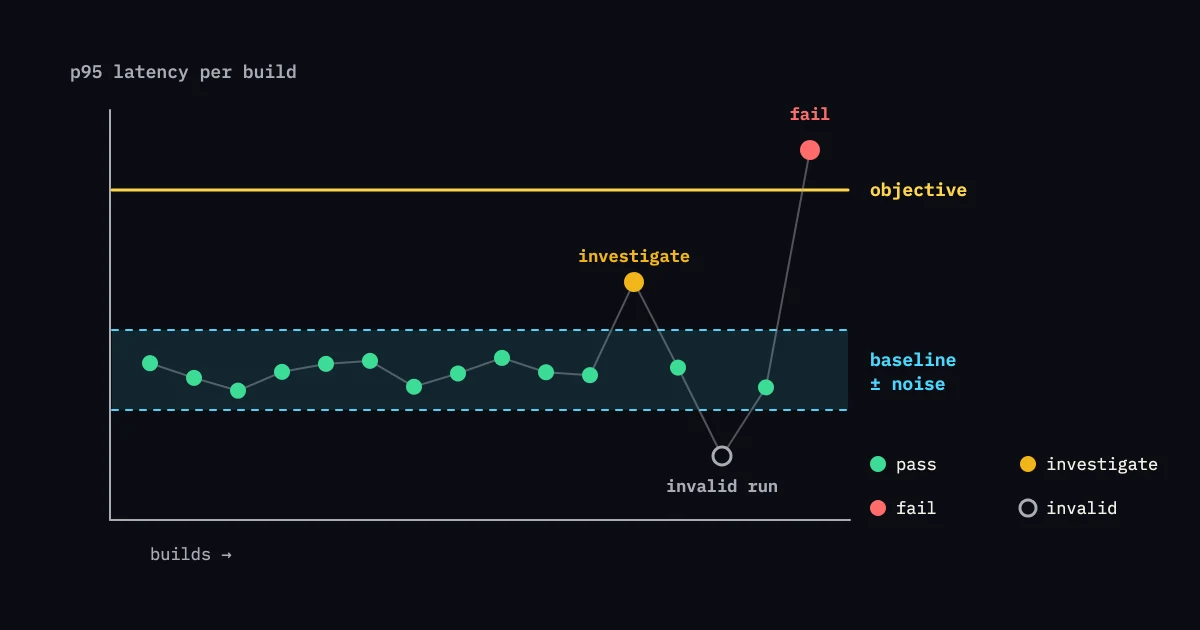
A threshold is a release policy. It does not describe what an endpoint usually does. A useful threshold catches a change that matters and tolerates known measurement noise. To get there, define the consequence first, then pick the signal and the comparison method.
Start with the user consequence
Turn “faster” into an outcome: checkout completion, search responsiveness, export completion, queue delay, or an error budget. A background job can have an objective measured in minutes, while sign-in may need a much tighter interaction budget. Do not give the same p95 to every route.
Define the boundary. Is latency server time, network time, or full browser navigation? Are retries included? Does a 200 with a failed business assertion count as a success? A threshold with an unclear boundary produces arguments instead of decisions.
Choose the right signals
Use a small set: a journey percentile, a business-success criterion, an error rate, an achieved-workload condition, and a relevant saturation signal. Add queue time or completion time for asynchronous work. Keep averages as context. Never make them the gate’s only criterion.
For a purchase flow, a defensible gate might require p95 under the agreed objective, zero lost writes, an error rate under the approved budget, and achieved arrivals within a stated tolerance. The system owner sets the exact values. The framework should not make them up.
Establish a comparable baseline
Run the same script, environment, data shape, load model, and duration often enough to see ordinary variation. Record cold and warm state on purpose. Compare distributions and sample counts. One lucky run is not a baseline.
If a release changes a dependency or region, do not compare it as if nothing changed. Create a new baseline or split the decision. No threshold can make up for an uncontrolled experiment.
Add tolerance without hiding change
Derive tolerance from observed variance and consequence. If p95 moves a little, inside normal noise, keep the gate green and record the trend. If it moves far enough to affect a user objective, fail or require review. Avoid a huge percentage cushion that turns every regression into “within tolerance.”
For noisy distributed tests, require repeated evidence or a manual review state. Do not pretend the number is deterministic. A comparative gate can be stronger than an absolute one when the environment is stable enough to compare, but write the rule down.
Gate in layers
Use a small deterministic check on pull requests, a broader scheduled run, and a representative release test. The CI/CD performance gates use case describes this cadence. PR checks should catch obvious regressions. They should not try to prove event capacity.
Make failure messages actionable: name the journey, signal, observed value, threshold, load, baseline, and whether the run was valid. If generator health or data exhaustion invalidates the result, report that. Do not fail the application for an unrelated reason.
Review thresholds as code
Store criteria next to the test artifact and review changes the way you review application code. Give every criterion a comment or a link to the objective it stands for. Remove thresholds that no longer map to a decision. A stale gate creates false confidence even while it stays green.
When a threshold fails, keep the result and compare the distribution. Do not raise the limit on the spot to turn CI green. Decide whether the product changed, the test changed, the environment drifted, or the measurement is wrong.
A threshold review checklist
- Does each criterion map to a user or service consequence?
- Are the timing boundary and retry treatment explicit?
- Is achieved workload checked separately from target workload?
- Was baseline variance measured under comparable conditions?
- Is the tolerance narrow enough to catch a meaningful change?
- Does a failure point to the next investigation?
Keep labeled runs for this comparison in whatever result store your team controls. Thresholds earn trust when they fail rarely, for reasons you can explain, and never hide the regression they exist to catch.
Example gate design
For a hypothetical search journey, the product owner may care about p95 completion, the API owner about error rate, and the platform owner about achieved arrival rate. Keep all three criteria. The journey p95 can fail while the API average passes. The error-rate criterion catches incorrect responses. The achieved-rate criterion stops an underloaded run from passing. Take the values from your team’s objective and baseline, not from this example.
When the gate fails, classify the failure before you retry. A product regression, environment drift, a generator ceiling, and an exhausted fixture each need a different owner. Keep the first result and attach the comparison baseline. A retry can give you evidence of noise, but it must not erase the original failure or quietly widen the threshold.
Thresholds should age well
Review criteria when the user journey, a dependency, data volume, or the objective changes. A threshold that suited a small smoke can be too loose for a release rehearsal, and an absolute limit can lose its meaning after a region change. Keep the rationale and date next to the rule. If the team cannot explain why a criterion exists, remove it through review. Do not leave a false signal in place.
For an objective you cannot measure yet, mark it as an evidence gap instead of inventing a threshold. Add instrumentation, or a manual review step with an owner and a deadline. An open gap protects trust better than a precise number with no link to customer impact.
Threshold review should include the invalid-run policy. A missed arrival schedule, exhausted data, a changed deployment, or missing telemetry must not quietly become a product failure. Classify it, keep the evidence, and route it to the right owner. The release gate then measures the product and not the fragility of the environment.
Example: a threshold that can be trusted
A threshold is an operating agreement, so record who reviews it and what event triggers the review. A route change, a new dependency, a change in data volume, or a materially different runtime can make an old objective irrelevant even when the number still looks familiar. Keep the original baseline and the conditions behind it, then decide whether the next run is comparable or needs a new starting point. When a gate fails, keep the full result and classify the outcome as an application regression, environment variance, incomplete coverage, or threshold maintenance. Do not let a temporary exception become a silent permanent edit. An explicit expiry or review trigger stops the gate from turning into a brittle obstacle or an inherited promise nobody on the current team can explain. The best threshold points to a decision and an evidence path. A colored status on its own does neither.
Say a checkout objective is that 99% of successful purchase attempts complete within the agreed customer window. The threshold has to identify successful attempts, keep the sample count, and leave intentional validation rejects out of the latency population while still reporting their rate. Add a separate assertion that an accepted order has exactly one durable outcome. A fast response with no order is not a passing checkout.
Give the gate three outcomes: pass, investigate, and invalid. Pass means the latency, business, and error criteria all hold with enough samples. Investigate flags a warning, such as rising queue age, while the hard customer criteria still hold. Invalid covers an exhausted fixture, a missed arrival schedule, a changed deployment, or missing telemetry. Retrying an invalid run can produce useful evidence, but the retry must not quietly turn into a product pass or failure.
Choose tolerance from comparison evidence. Repeat the same workload in the same environment enough times to estimate ordinary variation. Then set a gate that catches a change bigger than that noise and large enough to matter to the decision. Keep the baseline conditions next to the threshold. If a new dependency changes the route’s timing boundary, review the objective and the population. Do not copy the old percentile number.
Make the report actionable. Include the operation, scenario, sample count, percentile, achieved load, error classes, queue or dependency signals, and the investigation owner. A threshold earns trust when a failure explains which decision is blocked, which evidence is missing, and which smallest experiment can settle the question.
Review the gate after meaningful workload or architecture changes, even when the previous value still sits comfortably inside the range.