Facebook October 2021 Outage: What Happened and What to Test
Meta's engineers say a backbone command cut data centres off and DNS servers withdrew their BGP routes. What the postmortem says and the recovery tests it suggests.
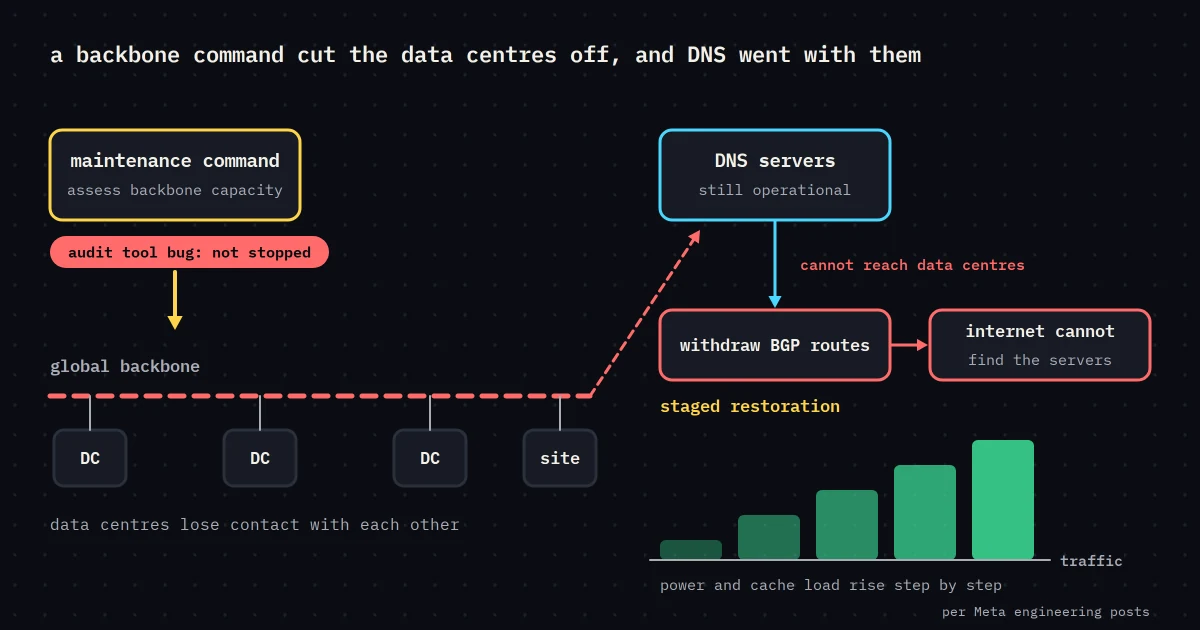
Meta’s engineering posts on the October 4, 2021 outage say it began during routine backbone maintenance. A command issued to assess backbone capacity disconnected the backbone globally, and a bug in an audit tool failed to stop it. DNS servers then withdrew their BGP routes, which made Meta’s services unreachable from the internet. The testing lesson is that recovery is a load event, and that the access and tooling you need during an outage must not depend on the system that failed.
This page separates what Meta’s account says from what a testing team infers. Every claim about the incident is attributed to Meta’s two posts: “Update about the October 4th outage” and “More details about the October 4 outage”.
What caused the Facebook outage in October 2021
The first post, published October 4, says engineering teams determined that configuration changes on the backbone routers caused the problem. Those routers coordinate network traffic between Meta’s data centres. The post calls the root cause a faulty configuration change on Meta’s side, says there was no malicious activity behind the outage, and says Meta has no evidence that user data was compromised. It adds that the root cause also affected internal tools and systems, which made diagnosis and repair harder.
The second post adds the mechanism. Meta’s global backbone links its computing facilities, from large data centres to smaller sites that connect the backbone to the internet. During routine maintenance, engineers were taking parts of the backbone offline for repairs and upgrades. The post says a command was issued to assess the availability of global backbone capacity, and that instead it disconnected the backbone globally. Audit systems normally block commands like that, but according to the post a bug in the audit tool prevented it from stopping this one.
This page uses no duration, user count or traffic figures, because it relies only on what those posts state.
How a backbone failure became a DNS failure
Meta’s second post describes a second failure inside the first. Its DNS servers answer lookups for Meta’s domains, and their addresses are advertised to the internet over BGP. Those servers withdraw their advertisements when they lose contact with the data centres. Once the backbone was down, they did exactly that. In the post’s words, the DNS servers became unreachable even though they were still operational.
The effect was that the rest of the internet lost the route to Meta’s servers. The DNS servers were applying a rule that makes sense in isolation (stop advertising when the data centres are unreachable), and the combination with a global backbone disconnect removed the name service entirely.
Test engineers take a narrow lesson from this. Safety behaviours such as withdrawing a route, failing a health check or shedding load are themselves part of the failure path. A load or resilience test that only checks “does the service survive more traffic” never exercises them.
When the recovery tools depend on the failed system
The second post says primary and out-of-band network access were both down, so engineers had to be sent to data centres. It also says those facilities are hard to get into, that routers and hardware are hard to modify even with physical access, and that secure access protocols had to be activated before engineers were allowed to work on the servers. The first post notes that internal tools were affected too.
The general question for your own system is which of your recovery paths share a dependency with production. Check this list in a design review before you run any test:
- The network path engineers use to reach management interfaces.
- The identity provider that gates access to consoles and runbooks.
- The chat, paging and ticketing tools you use to coordinate.
- The DNS zone that resolves your control-plane hosts.
- The deploy pipeline you would use to roll back a change.
If any of these resolve through, authenticate against or route over the platform you are trying to repair, write it down as a finding. A game day that quietly keeps those tools available proves less than it appears to.
Recovery is a load event
Meta’s second post explains why it did not turn everything back on at once. Data centres had reported drops in power usage in the range of tens of megawatts, and the post says a sudden reversal risked straining electrical systems and caches. So services were brought back gradually once backbone connectivity returned. The post credits Meta’s “storm” drills, which simulate large failures by taking services, data centres or regions offline, with preparing the team to manage the increasing loads carefully. It also says Meta had never simulated a global backbone outage before, and that the company would look for ways to simulate that failure and improve resilience.
For a performance team, the useful reading is that coming back is a workload with its own shape. When a service returns after a long interruption:
- Clients that were retrying all reconnect inside a short window.
- Caches are cold, so requests that were cheap become origin and database reads.
- Connection pools, TLS sessions and warm processes start from zero.
- Queues that built up while the service was away drain at the same time as new traffic.
- Power, network and autoscaling headroom are sized for the steady state, not for the first minutes after recovery.
The Roblox 2021 outage is a different incident with a different cause, but it points the same way: the recovery phase deserves its own test. Do not assume your steady-state load test covers it.
Test plan: staged restoration
You rehearse the part of this that belongs to your own services without touching anything global. Run it in an environment you are authorised to disrupt, with synthetic data and a named person who owns the abort.
- Write the recovery objective. Define the first healthy user journey, for example login then a read then a write, and the time and error ceiling that count as recovered. Process readiness does not count.
- Establish a warm control. Run the planned arrival rate against the healthy system and record latency percentiles, error rate, origin load and cache hit ratio.
- Introduce a bounded outage. Stop traffic to the service or its dependency for an agreed period. Keep the impairment short and reversible.
- Restore in stages. Return traffic in steps, for example 10, 25, 50 and 100 percent of the planned rate, and hold each step long enough to see whether queues, pools and caches settle. A staged ramp profile is the natural shape.
- Run the unstaged contrast. Repeat with traffic returning all at once. The difference between the two runs shows what staging buys you.
- Measure the reconnect surge. Record request rate in the first seconds after restoration against the steady-state rate. If clients retry without backoff and jitter, add a retry-storm scenario.
- Watch the cold path. Compare origin and database load while caches refill against the warm control. See cache stampede testing for how to isolate it.
- Check the recovery tools. During the outage window, try to reach dashboards, logs, runbooks and deploy tooling from outside the failed system. Record which ones failed.
- Reset and repeat. Confirm the next run starts from the intended state, then rerun after each fix.
Pass and fail criteria
Write the criteria before the run so nobody tunes them to the result. Useful gates for a recovery test include time to the first healthy journey, peak error rate during restoration, the maximum rate of requests reaching the origin while caches refill, queue age at each step, and a no-lost-work check where the service accepts writes. Add a hard abort if error rate or origin load crosses a ceiling you set in advance.
Record the decisions as well as the numbers. For each stage, note who decided to move to the next step and what evidence they used. A recovery that passes only because an operator held traffic back by hand is a result worth stating, because it describes a manual procedure you now have to keep alive.
Where MaxoPerf fits
MaxoPerf generates the traffic side of this experiment against services you are allowed to test. Its docs describe staged ramp profiles, fixed request-rate tests that use an open workload model, and failure criteria that mark a run failed when a metric such as p95 latency or error rate breaches a threshold. The docs also say a run stops its runners early on a breach when you enable early stop, which covers the hard abort above.
It does not model backbones, BGP or DNS withdrawal, and it does not replace a controlled failure injection in your own network. Use it to apply and measure the restoration load, and use your own fault-injection tooling to create the outage.
Keep the claims bounded
Write down what the source supports and what your experiment assumes. Meta’s posts support the claim that a backbone command, an audit-tool bug, DNS route withdrawal and staged recovery were part of the incident. They give no traffic profile to replay, and this page offers none. The restoration steps, ceilings and abort rules in your test are local assumptions, and each needs its own review before you run it.
Rehearsal checklist
- The recovery objective names the first healthy user journey, with a time and error ceiling.
- A warm control run exists and its latency, error rate, origin load and cache hit ratio are recorded.
- The outage is bounded, reversible, approved and has a named person who aborts.
- Traffic returns in at least four steps, and you hold each step until queues, pools and caches settle.
- An unstaged restoration run shows the difference staging makes.
- Reconnect rate in the first seconds is compared with the steady-state rate, and clients use backoff with jitter.
- Dashboards, logs, runbooks, paging and deploy tooling are reachable without the failed system.
- Every claim about Meta’s incident links to one of the two engineering posts.
- The abort rule, the decision log and the next-run reset are written down before the run starts.
Questions this article answers
What caused the Facebook outage in October 2021?
Meta's engineering posts say a faulty configuration change on the backbone routers caused it. During routine maintenance a command meant to assess backbone capacity disconnected the backbone, and a bug in an audit tool did not stop it. Meta says there was no malicious activity.
Why did the Facebook outage take DNS down too?
Meta's post says its DNS servers withdraw their BGP advertisements when they lose contact with the data centres. When the backbone went down, they did that, so the DNS servers became unreachable even though they were still operational, and the internet lost the route to Meta's servers.
Why was Facebook slow to come back after the outage?
Meta says engineers lost primary and out-of-band network access and had to be sent to data centres, where physical access is hard. It also says restarting everything at once risked power and cache problems, so services were restored gradually.
What do load testing teams learn from the Facebook outage?
Treat recovery as its own load event. Test staged traffic restoration, cold caches and reconnect surges, and confirm that the tools and access paths you need during an outage do not depend on the system that failed.
