When Taurus Is the Right Control Layer for Your Load Tests
Evaluate Taurus as a portable control layer when you need repeatable orchestration and reporting across supported load-testing engines.
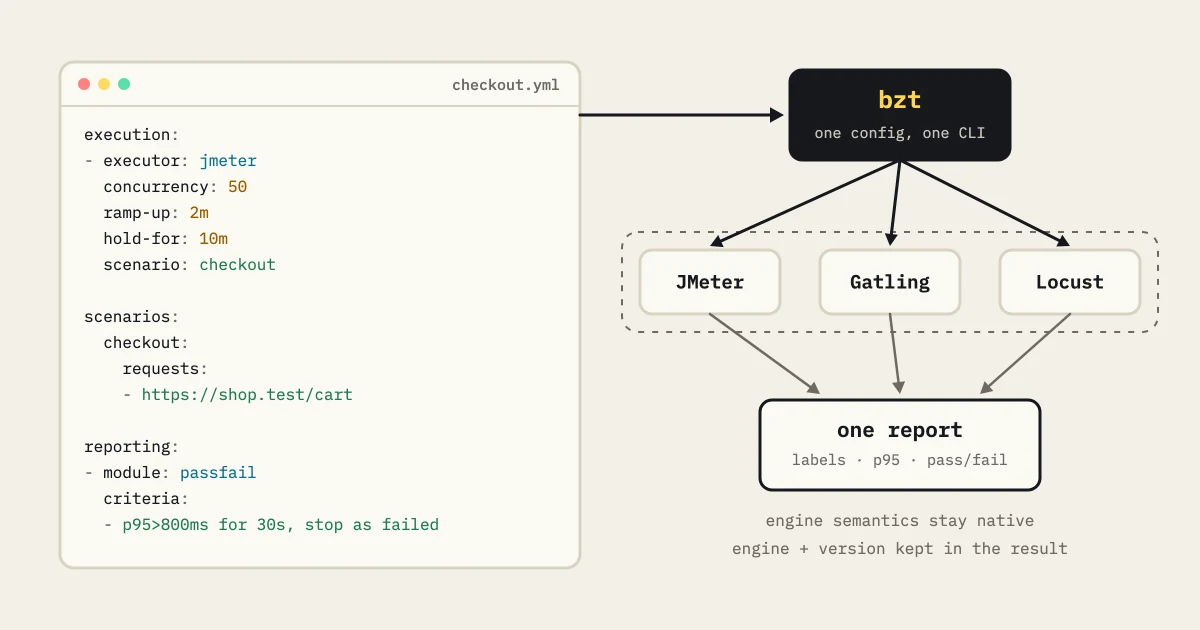
Taurus helps when your team wants one declarative control layer around several load-testing engines. It can standardize how scenarios are launched, configured, and reported, while each engine keeps responsibility for protocol behavior. That description is narrower than “universal performance solution,” and more useful.
Start the decision from workflow friction. Do engineers repeat commands, environment properties, ramp definitions, and result handling across tools? If so, a control layer can cut that repetition. If your team has one small script and no orchestration problem, another configuration layer may add more indirection than value.
Decide what needs unifying
List the parts that should be consistent: target configuration, test duration, reporting location, pass criteria, data files, and CI invocation. Then list the parts that must stay engine-specific: protocol implementation, correlation syntax, connection semantics, and engine tuning. A good layer standardizes the first group and does not pretend the second group is identical.
Keep engine names and versions visible in the result. A shared launch file does not erase real differences in thread scheduling, metrics, connection reuse, or assertion behavior. Reviewers need to know which engine generated the traffic.
The JMeter mode guide is a reminder that execution details matter even inside one tool. A wrapper should make those details easier to see instead of hiding them behind a friendly command.
Prefer one source of scenario intent
Define the scenario’s purpose, traffic shape, data assumptions, and success criteria in one reviewable place. A control layer can map those inputs to engine options, but you should be able to inspect the mapping. If a property changes ramp behavior, payload, or timing, say so instead of relying on a default.
Use environment-specific values as parameters, with safe defaults only for local development. Production targets, credentials, and private routes come from approved runtime configuration. Never put secrets in a portable test file because it makes a demo easier to run.
Keep data and correlation close to the engine that understands them. A generic variable name helps. A generic extractor that fails silently does not. Assert that required values exist before you pass them to another request. The control layer should fail early when an engine-specific prerequisite is missing.
Compare reports carefully
A shared report format makes runs easier to find, and it can also flatten important details. Keep operation labels, status classes, assertion outcomes, percentiles, throughput, and generator health. For streaming or browser scenarios, keep the lifecycle metrics the engine exposes. Do not compare two engines through one average if they measure different boundaries.
Record clock and aggregation context in distributed runs. Controllers and workers can have different jobs, so the control layer should state where samples are measured and how results are merged. The multi-region distributed-load guide covers the coordination and result-flow questions that remain after launch syntax gets simpler.
Keep exploratory output apart from a blocking gate. A wrapper can collect a report for an experiment without making every engine’s metric semantics interchangeable. Release criteria should name the source metric and its label.
Keep the abstraction thin
An abstraction is healthy when an engineer can drop below it to diagnose a failure. Keep the generated commands or expanded configuration as artifacts. Document how to reproduce a run directly with the underlying engine. That also gives your team an exit path if a feature outgrows the control layer.
Do not duplicate engine configuration in both a wrapper and a plan, because duplicated defaults drift. Give each setting one owner, and add a test or review check where the wrapper maps it. If the wrapper cannot represent a setting safely, expose it as an explicit engine-specific escape hatch instead of picking a value silently.
Version the control layer together with scenarios and engine versions. A change in defaults can alter arrival timing or result aggregation while the visible test file stays the same. Put the wrapper version in each run’s metadata, and review upgrades as workload changes.
Know when not to use it
Call the engine directly when the test is a small diagnostic, when the engine’s native tooling is the question, or when the wrapper cannot express a protocol feature without hiding its meaning. Use a specialized path for browser interaction, long-lived streams, or a custom protocol when the control layer’s assumptions do not fit.
Do not adopt Taurus to make every test look the same on a slide. Adopt it when portability, repeatability, and centralized execution matter more than the cost of the extra layer. Validate that decision with a small scenario and a direct-engine reproduction before you migrate a suite.
A practical evaluation
Judge the control layer against a real maintenance task, not only a first successful launch. Pick a small scenario that needs a variable, a threshold, a report artifact, and a second engine or environment. Ask how the wrapper passes configuration, how an operator stops a run, where partial output lands, and whether the underlying engine’s useful labels survive. Then have another engineer reproduce the run from a clean checkout. If the abstraction hides a setting needed for diagnosis, document the escape hatch or keep that scenario closer to the engine. A portable layer loses value when every meaningful exception turns into undocumented local knowledge. A short proof exercise exposes that tradeoff before your team standardizes on a wrapper and then finds that its reporting or failure semantics do not match how you operate.
Pick one existing scenario that runs in two environments. Express its target, data, ramp, duration, assertions, and output through the proposed control layer. Compare the expanded invocation and result with the current run. Can a reviewer see what changed? Does a failed correlation fail loudly? Can an operator find the artifact? If any answer is no, fix the mapping before you add more engines.
Taurus is a control layer. It does not replace workload design or observability. Use it where it safely removes repeated orchestration, keep engine semantics visible, keep direct reproduction possible, and tie decision criteria to real measurements. Portability then stays useful, and YAML does not become one more place for assumptions to hide.
For an evaluation, take one scenario with a login step, a dynamic token, a bounded ramp, an assertion, and a result artifact. Run it through the proposed control layer and directly through its engine. Compare the expanded properties, request labels, timing behavior, error classification, and output. If the two paths differ, find out whether a wrapper default or an engine feature caused it. That experiment gives your team a concrete adoption decision instead of a preference based on how the configuration looks.
Keep a short migration note for every supported engine: what the common fields mean, which options are native, and where the abstraction stops. Review it when you upgrade either layer. If a portable command cannot explain the workload it generates, it is not portable in any operational sense. It only moves hidden assumptions into a shared file.
The control layer should also make stopping safe. Define a bounded duration, an output location, and a cleanup path, and make sure an interrupted run leaves enough metadata to explain what happened. A wrapper that starts workers and hides their lifecycle adds operational risk. Test cancellation and partial-result handling before you make the abstraction the default entry point.
Put that safety check in the documentation and in a small repeatable smoke. You should be able to stop the wrapper, find the partial artifact, and tell which workers received work. Portability covers this operational path as well as the command that starts a test.
