Building a Production-Like Test Environment Without Cloning Production
Build a useful production-like performance environment by preserving bottleneck constraints, data shape, topology, and observability instead of cloning everything.
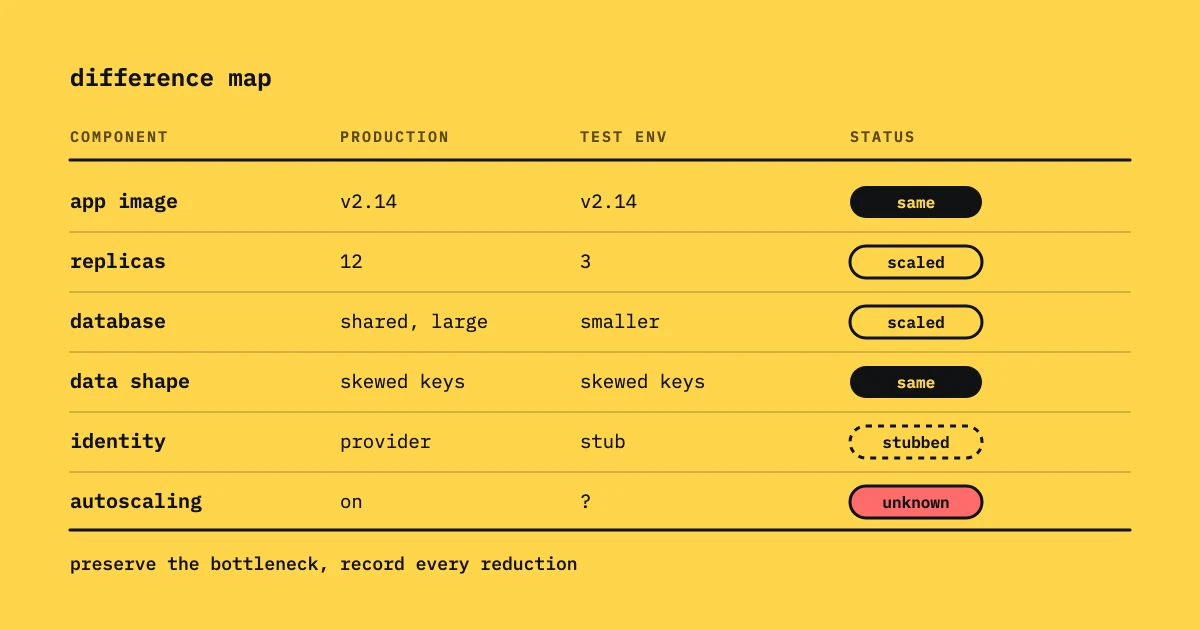
A production clone is expensive and can still mislead you. Looking like production is not the goal. The goal is to keep the constraints that govern the decision you need to make. Build a smaller environment on purpose, document how it differs, and test the same failure mechanisms.
Start from the bottleneck hypothesis
Ask what you are trying to learn. If you worry about database lock contention, keep the transaction shape, data cardinality, indexes, connection limits, and competing work. If you worry about edge caching, keep URL keys, headers, cache policy, payload sizes, and the network path. If you worry about queue drain time, keep queue semantics and worker concurrency.
The environment can be smaller in dimensions that do not affect the hypothesis. It cannot quietly change the one that does. Write the hypothesis next to every intentional reduction.
Map the performance contract
List application versions, dependency versions, replicas, CPU and memory limits, autoscaling rules, queues, pools, caches, storage, regions, and feature flags. Mark each one “same,” “scaled,” “stubbed,” or “unknown.” The same image does not give the same behavior when quota and topology differ.
Include the generator path. A local generator, an in-cluster worker, and a remote regional worker each exercise different DNS, TLS, routing, and latency. The private load generation pattern helps when the target is not publicly reachable, but placement still has to match the question.
Preserve data shape without copying people
Performance often depends on cardinality and distribution. A table with 100 rows does not behave like one with 100 million. A uniform key distribution does not behave like a few hot tenants. Generate synthetic records that keep sizes, relationships, skew, and realistic empty and full states. Do not copy personal data to make the fixture convenient.
Define allocation and reset. A test that reuses one account can warm caches and serialize writes. A test that creates a new row for every request can stress storage growth instead of the business path. Data policy belongs in the environment specification.
Model dependencies at the right fidelity
Use a real dependency when its latency, quotas, or state are part of the question. Use a deterministic substitute when you need to isolate the application, and record its response distribution and failure behavior. A fast mock proves application control flow. It cannot prove the real provider’s queueing or rate limit.
For asynchronous workflows, keep acknowledgement, processing delay, retries, and duplicate delivery semantics. For authentication, keep token size and expiry behavior without exposing credentials. For caches, define cold, warm, and mixed scenarios instead of one convenient warm run.
Make scaling behavior testable
Autoscaling is part of performance, not a deployment footnote. Record scale-up delay, maximum replicas, resource requests, quotas, and scale-down behavior. Run one ramp that gives scaling time to react and one spike that does not. The two results answer different questions.
If the environment cannot reach production’s size, compare behavior per instance or per worker and state your mapping assumptions. Do not multiply one small run linearly when shared locks, caches, network links, or quotas make scaling nonlinear.
Build observability in
Require request distributions, achieved workload, errors, queues, pool waits, and generator health. Add database, cache, dependency, and autoscaler signals where they test the hypothesis. Align clocks and carry a run identifier into logs and traces. Without the environment version and telemetry, a result is hard to read even when the test ran safely.
Use an environment fitness review
Before a major run, review the difference map with the application and platform owners. For each difference, ask three things. Could it change the conclusion? Can you measure its effect? Do you need a follow-up experiment? A short staging run can expose a generator ceiling or a cache mismatch before a long event rehearsal wastes time.
You own the environment contract. Keep the bottlenecks, state the reductions, and let the evidence tell you when a production-only test is justified. Attach the difference map to every capacity claim.
Difference-map example
Say production has twelve application replicas, a shared database, a regional cache, and an external identity provider. A test environment might use three replicas, a smaller database, and a deterministic identity substitute. A useful record says which limits scale linearly, which are shared, and which are absent. You can then test per-replica saturation, database contention, cache distribution, and application behavior separately.
If you map the result to production, present the mapping as a hypothesis: “the three-replica run identifies the query as the limiting mechanism; production capacity still needs a twelve-replica rehearsal.” Do not multiply measured throughput by four when the shared database is already near its limit. Run a focused database experiment instead.
At review time, ask an operator whether the test environment can fail the way production fails. If it cannot, name the missing experiment. That answer is useful evidence. It is not a license to call the environment production-like without qualification.
Keep the difference map next to every capacity conclusion. When a change removes one divergence, rerun the smallest experiment that depended on it before you repeat the full rehearsal. Environment work then builds up over time, and you avoid spending a full window rediscovering a known mismatch.
Include a rollback rehearsal when you use the environment for readiness. Verify that you can isolate a failed migration, an unhealthy dependency, or an overloaded worker without destroying fixtures. An environment that reaches peak but cannot return to a clean state is not safe for repeated rehearsals.
Record the environment’s reset procedure and prove it after a failed run. Resetting a cache, queue, fixture, or database can change the next test’s performance. Treat the reset as a named phase and report when it completes. A reproducible starting state is part of production likeness, even when the topology is smaller on purpose.
Choose fidelity by question, not by checklist. A cache-eviction experiment needs representative key cardinality and object size. It may not need production geography. A connection-limit experiment needs the same pool and database constraints. It may use synthetic records. For each planned test, write down the production property you approximate, the substitute you use, and what the difference costs you. Then add a failure-mode check: what happens if the substitute saturates first, loses network access, or resets without warning? The answer tells you whether to stop, rerun with a narrower claim, or move the experiment to a safer production canary.
Treat network shape the same way. A local test with zero packet loss and one region cannot show behavior under cross-region latency, DNS variation, or a dependency retry budget. Add only the impairment the question requires, measure it at the client and service boundary, and keep the control run beside it. If a timeout appears only after retries, inspect the total deadline before you call the first hop slow. Name these controls in the difference map so a future engineer can reproduce the condition without guessing at a proxy setting.
Use a readiness matrix to keep the claim bounded. For each dependency, record production behavior, the test substitute, the fidelity level, and the failure mode that stays untested. A smaller database may answer query-shape questions but not storage throughput. A single-region deployment may answer application behavior but not cross-region failover. During review, require every capacity conclusion to point to a row in the matrix. If no row supports it, classify the conclusion as exploratory and schedule a canary or a larger rehearsal. This habit stops “production-like” from becoming a vague badge that outlives its assumptions.