Pokémon GO at 50× Forecast Traffic: Planning for the Estimate You Missed
What the Pokémon GO launch teaches about forecast multiples, quotas, partner readiness, adaptable architecture, and testing beyond one estimate.
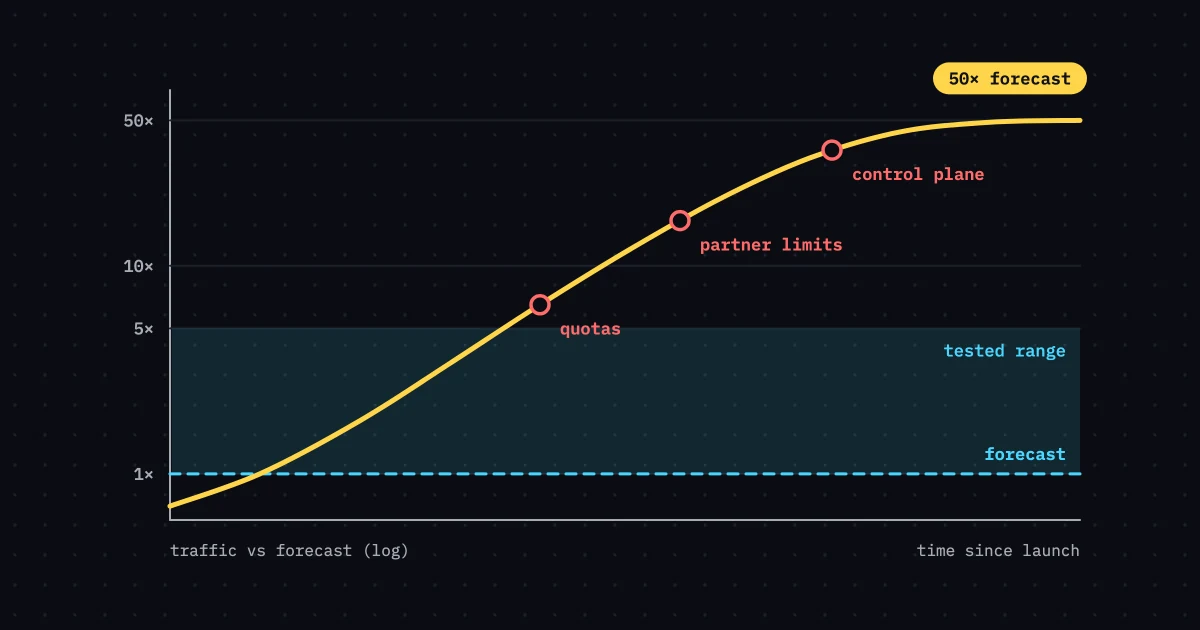
People often remember the early Pokémon GO launch as a traffic forecast that was too low. The more useful lesson is wider: a forecast is a planning input, and it guarantees no capacity. When adoption changes the shape of the system, teams need multipliers, quotas, partner checks, and an architecture that can adapt while everyone is still learning what demand looks like.
Google Cloud’s account, “Bringing Pokémon GO to life on Google Cloud”, describes the launch pressure and the engineering response. This article stays close to that primary source and does not turn the reported experience into a universal traffic benchmark. The practical question is how to design tests and operating decisions when the estimate itself is uncertain.
Forecasts are ranges with consequences
A launch forecast should include a central case, an upside case, and a case built around failure. The goal is not to pick a dramatic multiplier for its own sake. The goal is to show which assumptions change when adoption, geography, concurrency, session length, or request mix moves. A single number makes planning look finished before anyone has asked the important questions.
Turn each case into work. How many users arrive in the first window? How many stay active? Which endpoints or game actions dominate? Does each session open connections, poll, publish, or fan out? The capacity-planning guide describes how to convert an event forecast into a traffic model.
Keep your confidence levels visible. If an assumption rests on a partner’s estimate, mark the dependency. If you inferred a request mix from an earlier product, label it as an analogy, not a fact. The uncertainty is part of the plan and should shape the test matrix.
Test the multiplier, not only the midpoint
Run the central case to confirm normal behavior. Then apply bounded higher cases to find out what changes first. Higher pressure can expose quotas, worker ceilings, connection limits, queue growth, or database behavior that stays hidden at the midpoint. Give each case a safety boundary and a stop condition.
Do not call the highest case a prediction. It is an experiment that asks whether the system fails gradually, rejects safely, or collapses at a hard edge. Record the first limit, the protection behavior, and the recovery path. A system that returns a clear, bounded error may be healthier than one that accepts work until every dependency times out.
Include a ramp that looks like the event. A slow increase and a synchronized wave of arrivals stress different controls. A long, steady population shows leaks and queue buildup. Name these as separate scenarios so no single result claims to cover every launch shape.
Quotas are capacity dependencies
Cloud resources and partner systems often have quotas that are separate from application compute. Check the limits for addresses, connections, storage, messaging, APIs, and every service in the user journey. Test the request path that uses up the quota, and watch how the client behaves when it hits the limit.
Give each quota an owner, a review date, and a tested mitigation. Raising it may need lead time, a regional choice, or partner approval. Treat the change as part of release readiness. It should not be an emergency command that lives only in a runbook.
Measure control-plane work too. Provisioning, configuration rollout, cache warming, and partner registration can become the bottleneck before steady-state request capacity does. A launch plan that only tests application workers that already exist may miss the process that makes new workers useful.
Include partners and shared boundaries
The customer journey rarely stops at your service boundary. Authentication, maps, payments, notifications, analytics, and content delivery may each have their own limits and failure policies. Decide which dependencies are real in each test and which are controlled doubles. Get permission for any exercise that touches a partner, and stay within their rate limits.
A double should reproduce the behavior that matters: latency, errors, payload size, throttling, and recovery. A stub that is always fast can make the system look ready while the timeout and retry paths go untested. Do not swing the other way and add arbitrary delay to a capacity run, then treat it as a statement about the partner. Keep each scenario’s intent explicit.
Design for adaptation during the event
When demand passes the central forecast, operators need levers. Admission control, feature reduction, queueing, cache policy, regional routing, and graceful degradation can protect the most important path. Test those levers at the same traffic shapes you use for capacity.
Recovery needs its own wave. Clients that were rejected or disconnected may all come back together after a mitigation. Test bounded reconnect and retry behavior, and check that the recovered path has enough headroom to absorb it. The peak-event runbook covers how to make that recovery work observable.
Make decisions reversible where you can. A runbook should name the signal that triggers a change, the owner who approves it, and the signal that confirms recovery. Performance testing cannot guarantee that an event will match the forecast. It can make your response to a wrong forecast less improvised.
Report what the test means
Write the forecast assumption next to every scenario: what was estimated, which multiplier you exercised, which quotas you checked, and which part of the architecture was allowed to adapt. Keep partner and operator responsibilities visible, because a surge can cross organizational boundaries even when the application code is healthy. A run that validates a stateless service does not validate geospatial data, authentication, queues, or support workflows. Use the official Google Cloud account as historical context. Do not use it as a template for a made-up traffic claim. In a rehearsal, pick a safe target, define a stop signal, and watch both what customers see and the controls meant to protect them. Afterward, record which assumption held, which stayed uncertain, and what evidence would settle it. You end up with a planning multiplier the team can explain, without pretending you can rebuild an incident’s exact traffic pattern from a public write-up.
A useful launch report covers the tested cases, assumptions, first limits, protection behavior, quotas checked, partner conditions, operator signals, and recovery evidence. Keep observed facts apart from planned mitigations. Avoid a bare “supports X users” sentence unless the workload and conditions come attached.
The Pokémon GO story does not mean one multiplier fits every product. It shows that growth can break the model you used to size a launch. Test ranges, look at boundaries beyond application CPU, coordinate dependencies, and practice adapting. A missed estimate then becomes a scenario the team prepared for, not a surprise that rewrites the plan in production.
In a launch review, ask what evidence exists for each case and what action follows each limit. If the upside case hits a quota, the action may be an approved increase. If it hits a partner limit, the action may be a feature change or a traffic policy. If the origin stays healthy while the edge rejects legitimate sessions, a different owner acts. Writing these branches down before launch turns an uncertain forecast into a set of decisions instead of one reassuring capacity number.
Include a communication path in that review. The person watching quota, partner health, origin saturation, and customer symptoms may not be the person who can change the system. Name the handoff and the evidence it needs. Even a sound test loses value when its first actionable signal arrives with no owner, or when operators cannot tell which mitigation is already in place.
