How to Organize a k6 Test Suite for a Growing Engineering Team
Organize a k6 suite with explicit scenarios, environment adapters, checks, shared primitives, and reviewable ownership.
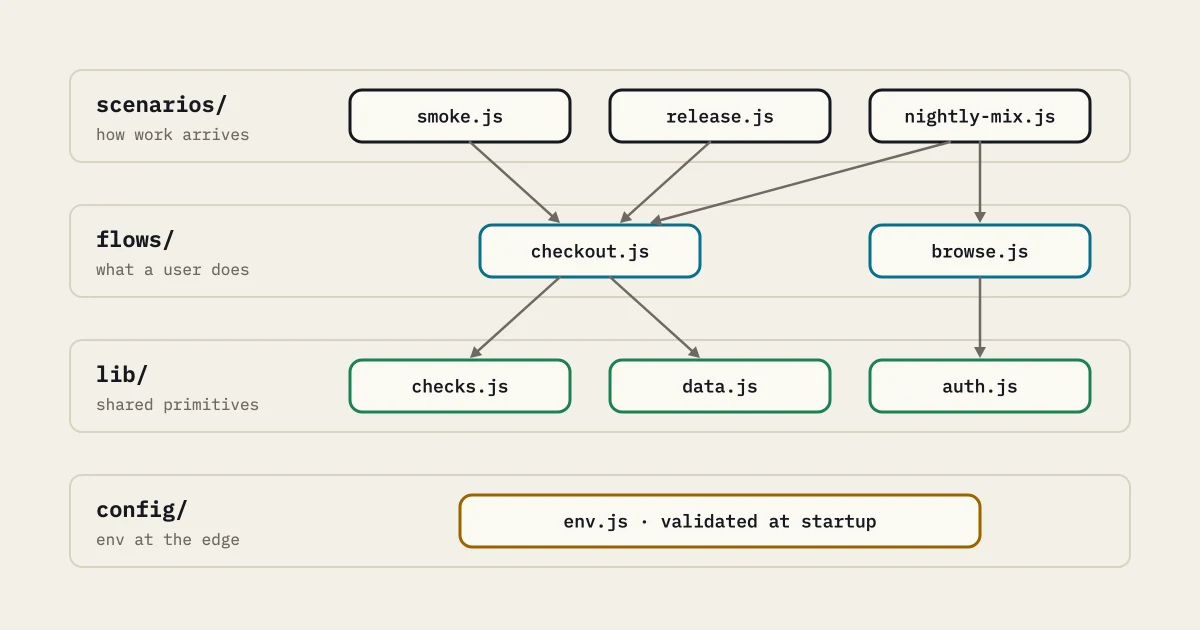
A growing k6 suite needs boundaries before it needs a framework. Put scenario intent, environment configuration, business flows, checks, and data ownership where a reviewer can find them. Aim for the shortest path from a failing result to the line that explains the workload. The number of files matters less.
Separate scenarios from flows
A scenario describes how work arrives: a closed population, a fixed arrival rate, a spike, or a soak. A flow describes what an actor does. Keep the two apart, so the same checkout flow can run in a smoke scenario and in a release rehearsal without copying its assertions.
Name scenarios after the decision they support as well as their tool setting. checkout-release-candidate tells you more than scenario2. Record ramp, hold, pacing, data partition, and stop conditions next to the scenario.
Keep environment adapters boring
Put target origins, safe defaults, and approved environment configuration in one place. Do not scatter string concatenation across every request. Validate required values at startup and fail with a clear error when a target is missing. Do not add hidden test-only switches that make local behavior differ from staging.
Keep secrets out of source, labels, logs, and result names. Use the repository’s credential path and synthetic data. An environment adapter should pick a boundary. It should never quietly rewrite the workload.
Make flows read like journeys
Group setup, authentication, browse, mutation, verification, and cleanup into small functions with clear inputs and outputs. Return extracted IDs or tokens explicitly. A helper that reaches into global state can make parallel users share data by accident.
Add checks at business boundaries: status, response shape, identity, and state. Keep checks separate from timing labels so a failed assertion stays visible. If an operation is asynchronous, poll with a bounded policy and report completion separately from acceptance.
Treat data as a module
Decide whether records are shared, finite, partitioned, or unique. Allocate them deterministically where you can, and fail when the pool runs out instead of quietly reusing a record. Keep cleanup rules next to the flow that creates the state. That stops a “reusable fixture” from turning into an accidental cache or lock experiment.
Use tags as the result contract
Tag business transactions, endpoints, scenarios, environment, and data mode the same way everywhere. Report latency and errors by those tags. Keep user IDs, email addresses, tokens, and internal secrets out of labels. Stable labels make historical comparisons possible.
Test the suite itself
Run one actor, then a small cohort, before you scale out. Check that every scenario reaches its planned rate, that every assertion catches a response you broke on purpose, and that cleanup runs after a failure. Check the generator’s own CPU, sockets, and bandwidth. Do not use a suite as a release gate until it passes these basics.
Resist a giant abstraction layer
Share only repeated behavior with a stable meaning: request helpers, authentication primitives, common checks, and data allocation. Keep scenario-specific pacing and decisions visible. A framework that hides every request behind five layers can cut duplication and still raise the cost of review.
The k6 Academy material covers engine-specific details. Keep ownership in the suite: organize around intent, make state explicit, and let the test file state the demand accurately.
A practical repository shape
Keep a scenario entry point, a small flow module, a data allocator, and checks that explain business outcomes. Resolve the environment at the edge. Give each scenario a short README section with its model, ramp, hold, data, and thresholds. That is enough structure for a team to grow without building a framework before real repeated needs show up.
When a flow changes, run its one-user proof and a small scenario in a controlled environment. Return an invalid payload on purpose to confirm its check still fails. Review labels for stray IDs and response logging for secrets. Test code in the suite needs the same safety discipline as application code.
Use a maintenance checklist in review. Scenario names describe decisions. Environment values are validated at the edge. Data allocation is explicit. Checks fail on a malformed success. Labels contain no sensitive identifiers. The one-user proof still passes. Before a shared helper becomes a suite-wide primitive, a second scenario should demonstrate what it means.
Keep a deprecation path for old flows. When you replace a scenario, record why and keep its last comparable result. Do not leave two quietly different versions in scheduled runs. Prefer ordinary modules and small fixtures over a custom runner framework. The simplest suite is one an engineer can read from entry point to assertion without a map.
Readability pays off in speed: it shortens the path from a failed assertion to a corrected workload.
Review a suite change safely
Treat a test-suite change as a workload change, even when it looks like a refactor. Before you merge, compare the old and new scenario graphs: which requests moved, which tags changed, where pacing and retries live, and whether setup or cleanup moved into the measured window. A helper that looks equivalent can change connection reuse, data allocation, or the point where an iteration starts. Write those differences in the review description.
Use a narrow proof sequence. Run the one-user journey with a known fixture, then a small cohort with the normal data partition, then the intended executor at a modest rate. Compare business assertions, achieved starts, request counts, and labels at each step. If the request count changes, inspect the flow before you accept a performance difference. If only a label changes, update dashboards and baselines on purpose so you do not create a false regression.
Keep scenario configuration explicit at the boundary. Validate required environment values before workers start, reject an unknown mode instead of quietly picking a default, and show the selected scenario in the result. Put secrets in the approved runtime mechanism and have logs redact them. A test that fails clearly during setup is easier to run than one that reaches the target with an empty URL or a shared credential.
Review parallel safety as the suite grows. Give each worker an allocation rule for mutable records, bound retries, and make cleanup idempotent. If you cannot partition a fixture safely, run that scenario with a bounded population and state the limitation. Never use a shared mutable account just because it makes the script shorter. It can serialize the path and hide the contention you need to measure.
Last, keep a small regression test for the suite itself. Assert that scenario selection, tags, fixture allocation, and one representative business check still behave as documented. That check does not prove service capacity. It stops future abstractions from quietly changing the workload contract.
Example: review a new journey
Say a team adds checkout to a suite that already covers browsing. First decide whether checkout is its own scenario or one branch of a mixed profile. The decision drives the answer. Payment capacity needs controlled inventory and idempotency assertions. Browse capacity needs broad read data. Keep the two flows runnable on their own, even if they share authentication and navigation helpers.
Before you merge, compare the request trace of one iteration with the product flow. Confirm that the cart ID comes from the response, that the payment request uses a unique synthetic order, and that cleanup runs after both success and timeout. Add tags for journey and outcome class, then run a one-user proof that rejects a successful HTTP response carrying a failed order state. Only then should the journey go into a multi-worker schedule. This review catches changes in meaning while the diff is still small.