Load Testing Microservices Without Creating an Unrealistic End-to-End Test
A microservices load-testing strategy that combines service-level pressure, a few realistic journeys, and dependency observability without fiction.
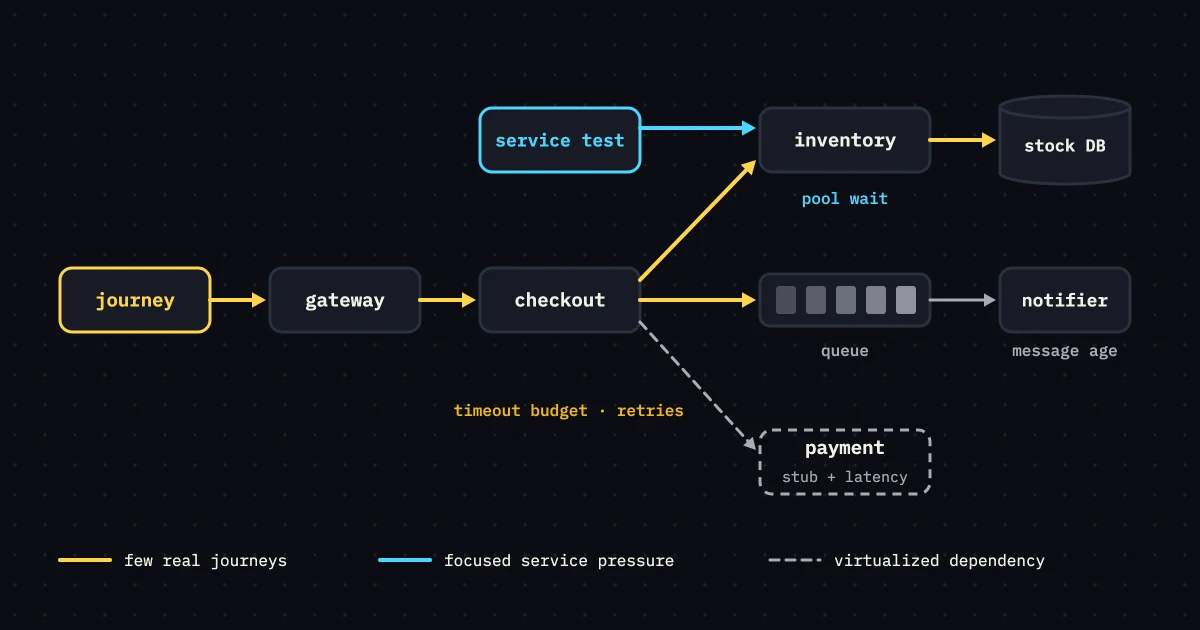
Microservices load testing fails when a team picks one of two extremes: one giant user journey that nobody can diagnose, or isolated service tests that look nothing like real traffic. Use both levels on purpose. Service scenarios show local saturation. A few end-to-end journeys show contracts, queues, retries, and how failures spread.
A test is realistic when its assumptions are visible. You should be able to say which services get pressure, which dependencies are real or simulated, how data flows between calls, and which user-visible outcomes you assert. Hitting every service at once is not automatically production-like. It may be a synchronized storm your architecture never produces.
Map traffic before writing scripts
Start from request paths, not service names. Pick the journeys that matter to users and draw the calls they make, asynchronous work included. Record the expected request mix, fan-out, payload sizes, cache conditions, authentication path, and dependency behavior. A browse journey may be read-heavy. A publish journey may touch storage, search indexing, and notifications.
Then write down the service-level questions. Does the catalog service hold its latency at the expected request rate? Can the order service protect its database when payment is slow? Does the queue consumer drain work without unbounded lag? Each question gets a focused scenario, with labels that show which component is responsible.
The realistic-load guide helps you document the traffic model. Treat the model as a versioned input, not a paragraph buried in a test plan.
Use three complementary layers
At the service layer, send controlled pressure to one boundary and watch its dependencies. Keep upstream authentication and data setup realistic enough that you do not skip the work you mean to measure. Service tests are where you can change one dimension at a time and find a bottleneck.
At the contract layer, check that services talk to each other correctly under concurrency. Cover timeouts, retries, idempotency, message ordering where it matters, and partial dependency failure. A service can have acceptable local latency while its client sees failures, because a timeout budget gets used up across several hops.
At the journey layer, run a few end-to-end flows in representative proportions. Leave most endpoints out. Pick paths that cross boundaries and say something meaningful about the user experience. Keep the number of journeys small enough that a failure leads to the next experiment instead of a week of digging through logs.
Decide what to virtualize
A dependency can be real, stubbed, or replayed. Use the real one when its capacity and behavior are part of the question and the environment is safe. Use a controlled double when an external system is unavailable, expensive, rate limited, or not yours. This choice defines what the result means, so treat it as a decision and not a shortcut.
Make the double’s behavior explicit. A fast stub can remove the queueing and error modes that matter in production. Add controlled latency, errors, payload variation, and throttling when those conditions belong in the scenario. Do not add random chaos to every run, though. Keep a stable capacity test apart from a resilience experiment so each one has a clear reading.
For private targets and internal dependencies, isolate load generation and network access on purpose. The private load-generation guide covers the boundary decisions that keep target traffic inside an approved network path.
Observe the seams
Collect latency and errors at each service boundary, and link them with a request or scenario ID. Look at queue depth, connection-pool wait, lock contention, cache hits, retry volume, and message age next to endpoint percentiles. When a downstream p99 rises, upstream latency may stay acceptable until the timeout budget runs out. A single top-level chart cannot show that progression.
Give retries their own label or counter. A request that succeeds after two retries is not the same as a first-attempt success, especially when the retries add load to a dependency. Show rate limits and circuit breakers as expected states instead of lumping them in with generic failures.
Track the load generator as well. In a distributed run, one overloaded worker can cause misleading gaps, skewed arrival rates, or the false impression that a service shed traffic. Record worker health and clock context with the result.
Test data and side effects
Microservices often share identifiers while each owns different records. Prepare data through supported interfaces or safe fixtures, and make ownership boundaries clear. A test that writes to only one service’s database can leave another service in a state that cannot exist in production. Use unique namespaces, idempotent setup, and cleanup you can audit.
For asynchronous flows, define what completion means. Is it enough that a message was accepted, or does a consumer have to update a read model? If the product promises the second, measure both. Do not wait forever for eventual consistency. Use a documented timeout and record whether the delay came from the producer, broker, consumer, or query path.
Turn failures into next tests
If the journey slows while one service’s pool wait grows, rerun that service with the observed arrival shape. If errors rise only after retries, set up a controlled dependency-latency test. If the end-to-end path fails while every service test passes, look at contracts, timeouts, data, and coordination. Do not just raise the load and hope.
A good report says which layer failed, which assumptions held, and which assumption still needs checking. It does not give a universal capacity number for a distributed system. It gives evidence about a named traffic model and a set of boundaries.
Service pressure and user journeys should inform each other. Keep the end-to-end set small on purpose, keep focused scenarios diagnostic, keep virtualized dependencies honest, and watch the seams where work changes shape. Teams can maintain tests built that way, and operators can trust the decisions that come out of them.
Keep ownership in the result
Name the route, service revision, dependency mode, and traffic assumption for every experiment. A service test against a stub can answer a capacity question about that service. It cannot prove that production retries, serialization, or network policy behave the same way. A broad journey can prove a customer symptom without showing which service owns the delay. Pair the two scopes on purpose and link their run records. When a queue, cache, or feature flag changes the path, put that state in the scenario label. Also record whether the test covers one tenant, several tenants, or shared data, because isolation can change cache behavior and database contention. A result that reflects the topology keeps follow-up work small: the owning team can reproduce the relevant boundary with the same dependency assumptions instead of rerunning every service at once.
Every scenario should name the service owner for its assertions and the platform owner for shared test infrastructure. The point is to make follow-up possible, not to assign blame. If a dependency is virtualized, name the behavior its owner must validate separately. If a journey crosses a queue, record who owns the producer, the consumer, and the completion signal. With clear ownership, a broad distributed failure becomes a sequence of bounded experiments, and the report still reflects that the customer experiences the whole path.
Take a checkout journey whose top-level latency rises only when inventory responses slow down. The first follow-up belongs at the inventory boundary: reproduce the observed arrival rate, inspect its pool and timeout behavior, and check whether retries multiply the work. The journey run still matters because it proves the customer symptom. The service run gives you the smaller experiment. Recording both owners and links stops the team from rerunning the largest scenario over and over without learning which seam moved.