Load Testing Authentication, Sessions, and Token Refresh Safely
Test login capacity separately from authenticated traffic and model expiry, refresh, session state, and credential safety without leaking secrets.
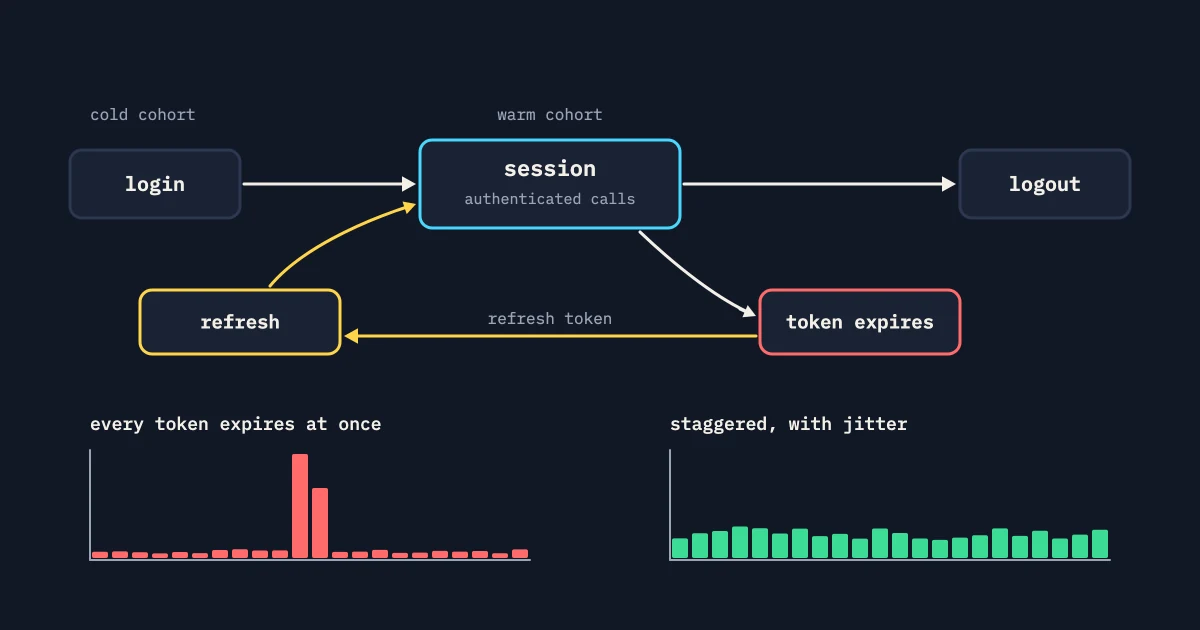
Authentication is a workload in its own right and also the gate to the workload behind it. If every virtual user logs in during the main scenario, your result may measure an artificial login storm. If every user signs in once and never refreshes, you may miss the session failures that show up over a long release day. Model the two paths separately.
Separate login from business traffic
Run a login-capacity scenario with its own arrival shape, data partition, and criteria. When login is not the question, run authenticated business journeys with pre-issued or safely established sessions. Then add a representative background cohort that logs in or refreshes, if that interaction matters.
Track authentication latency, token issuance errors, session-store work, and downstream journey success separately. A successful login does not prove the first authenticated request can use the token.
Use synthetic identities carefully
Create enough test accounts for the planned concurrency and duration. Decide whether each identity is unique per actor, reused across read-only flows, or rotated. A shared account can serialize writes, warm a cache, or hit device limits. Unique accounts expose realistic allocation and storage pressure.
Never put passwords, tokens, cookies, or personal fields in source, tags, logs, screenshots, or result labels. Use the established secret reference path and scrub response bodies. Keep test data synthetic and disposable.
Model token lifetime
A short smoke may never reach expiry. A long session should cross the token lifetime on purpose, with the refresh, reauthentication, and failure paths all present. Record whether the client refreshes before expiry, retries after a 401, or asks the user to sign in again.
Bound refresh retries and add jitter where real clients would. If every client refreshes in the same second, you get a thundering herd. A test that keeps refreshing forever after an invalid token is a denial of service generated by the client. It is not a valid workload.
Test session state
Sessions may live in a database, a cache, or application memory. Measure creation, lookup, expiration, eviction, and replication where those mechanisms are in scope. If the product relies on stateful sessions, test a rolling population, reconnects, multiple devices, and a restart.
Check authorization boundaries with safe identities. A token for one synthetic tenant must not read another tenant’s data. Keep these checks in a separate security-aware scenario, and fail loudly on any unexpected authorization result.
Include dependency limits
Identity providers and email or challenge services may have quotas and latency that differ from your application. Stub or isolate them only when their behavior is not part of the decision. If you use the real ones, get authorization and set a conservative ceiling. Record the boundary so nobody reads a login result as application capacity.
Validate the flow before scale
Take one identity through login, an authenticated read, a mutation if that is safe, refresh, expiry, logout, and cleanup. Inspect the state transitions and assertions. Then run a small cohort and check that tokens stay isolated, refresh timing is spread out, and generator health stays under its ceiling.
The designing realistic load guidance shows where authentication fits in the wider journey. The safe pattern holds for every system: separate login from business traffic, model lifetime explicitly, and keep secrets out of results.
A session test matrix
Use rows for fresh login, warm session, refresh before expiry, expired token, logout, reconnect, and concurrent device. For each row, define identity allocation, expected status and business outcome, effect on the session store, retry policy, and cleanup. Run fresh login apart from the authenticated mix so a login spike cannot hide a regression in the business path.
For a long rehearsal, stagger token expiry instead of expiring every identity at once, unless synchronized refresh is the risk you are testing. Run that synchronized case as a named stress scenario with a conservative ceiling. Inspect refresh requests, cache or database writes, and downstream success. The result should tell you whether users can keep working safely, not only whether the identity endpoint stayed fast.
Keep login, refresh, and business journeys in separate result groups, even inside one rehearsal. If authentication latency rises, the team can tell an identity-provider limit from a downstream regression. If a token is rejected, keep the status and business assertion, and do not log the token.
Add a rule that invalidates the run on credential or fixture leakage. If a response, label, or log contains a secret, stop the run and rotate the affected test credential before you share results. Security hygiene is part of authentication performance work. A fast login is not worth an exposed token.
Record the authentication scenario’s scope and expiry policy, so a later reviewer can reproduce the safe boundary without seeing any credential value.
Connect identity pressure to business capacity
Authentication has at least two resource curves. Cold sessions load the identity provider, token signing, user lookup, and rate limits. Warm sessions load the protected application and its dependencies while holding cookies, tokens, and server-side state. Run the two curves separately first. Combine them only when production has login churn during business traffic.
Use a transition matrix for a concrete experiment. For login, refresh, expiry, revocation, and logout, define the starting state, action, expected status, resource touched, and cleanup. A refresh test, for example, should assert that the new token works and that the old one is treated as expected. A revoked-session test should prove that a protected write cannot complete after revocation. These are correctness boundaries, and they also decide whether retries create duplicate work.
Pick a credential pool based on the limiting policy. If limits are per account, spread accounts across workers. If limits are per client, do not vary identity or client without recording the change. A shared account can work for a read-only warm-session control. It models profile mutation or lock contention badly. Report pool size, reuse interval, expiry window, and any generator-side throttle alongside achieved arrivals.
Trace without exposing secrets. Tie token issuance, protected calls, refreshes, and business completions together with an opaque run or transition ID. Redact authorization headers, cookies, email addresses, and token claims in logs and artifacts. If a failed assertion needs to print a credential, the diagnostic boundary is in the wrong place. Stop and rotate the test credential if secret material shows up anywhere outside the approved runtime channel.
Finish with recovery evidence. Drain asynchronous work, revoke or delete the synthetic identities, check that refresh loops stop after logout, and compare cold and warm resource usage. A good authentication test explains which state was loaded, which boundary saturated, and whether the next run starts clean. A count of successful logins is not enough.
Example: choose the right authentication profile
Say a release cuts token lifetime from one hour to fifteen minutes. A cold-login test alone misses the extra refresh traffic from long sessions. A warm-session test alone misses the signing and account-lookup work at login. Build two profiles: a cold cohort that signs in once, and a long-session cohort that crosses expiry on purpose. Keep total business arrivals comparable, and report refreshes as a separate operation.
In the long-session profile, stagger expiry instead of expiring every token at the same instant, unless a synchronized reconnect is the risk. Assert that a refresh returns a usable token, that the old token follows the documented policy, and that a failed refresh does not replay a write. Watch identity-provider rate limits, application authorization latency, downstream calls, and client retries. If refresh traffic rises while business throughput holds steady, the capacity decision may belong to the identity boundary and not the application.
Make fixture recovery explicit. If a worker stops halfway through the matrix, mark its identities for revocation and reconcile them before the next run. Keep only counts, durations, and opaque transition IDs in the results. The token-lifetime change becomes a measurable workload delta, with no exposed credentials and no mixing of login capacity with session capacity.