Healthcare.gov’s Launch: What Incomplete End-to-End Testing Costs
The GAO's Healthcare.gov review shows how capacity, integration, pass criteria, requirements, and launch governance fail together.
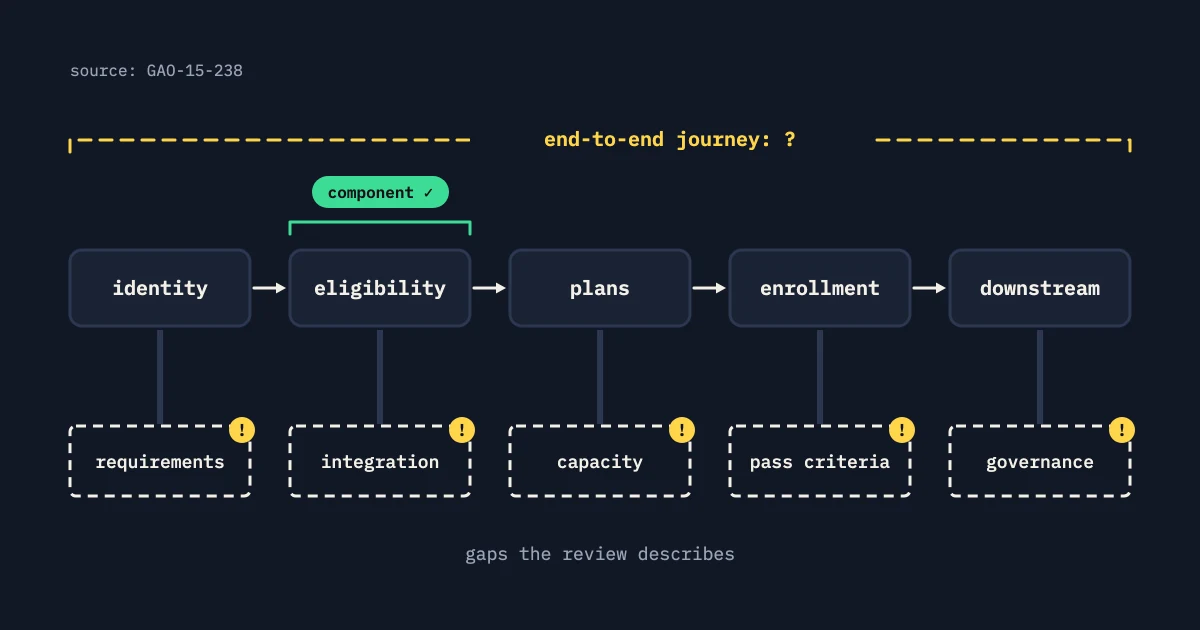
People often sum up the Healthcare.gov launch as “the site was not load tested.” The U.S. Government Accountability Office’s review is more useful and more specific. It describes gaps in requirements, integration, capacity testing, performance criteria, and governance. The lesson: a passing component test cannot make up for an incomplete end-to-end release system.
Follow the primary record
The GAO report, Healthcare.gov: CMS Has Taken Steps to Address Problems, but Needs to Further Implement Systems Development Best Practices, is the source for the material claims in this article. It covers the federal marketplace’s development and launch problems and the GAO’s recommendations. This article infers no single technical root cause beyond what the report supports.
Capacity is one slice of the system
A capacity test can show that a component handles a chosen workload. It cannot show that the whole user journey works when identity, eligibility, plan selection, enrollment, external data, and downstream processing interact. The end-to-end path can have different limits, timeouts, and failure handling than any isolated service.
That difference should change your test portfolio. Keep service-level tests for diagnosis and scale. Add a few end-to-end journeys with realistic dependencies, data, and assertions. A component result is still useful, as long as you label it as component evidence.
Requirements decide what “pass” means
The GAO review points to weaknesses in requirements and performance criteria. You cannot prove readiness against a promise nobody defined. Before scripting, specify the users and journeys, expected demand, response-time and completion objectives, error handling, the accessibility or functional conditions in scope, and what makes a run invalid.
For an enrollment flow, “the page loaded” is not enough. The test should check the correct user state, data, downstream acknowledgement, and final completion where that applies. It should also say what it does not cover.
Integration changes the failure surface
External services, shared databases, queues, authentication, and network controls can turn a local success into an end-to-end failure. Integration tests should keep the contracts and timing boundaries that matter. If you stub a dependency, record which evidence the stub removes.
Use synthetic data with plausible relationships and cardinality. Test expired sessions, retries, slow dependencies, partial responses, and recovery. When a public service has to stay useful while one dependency is degraded, these are core cases, not extras.
Governance is a technical control
Release ownership, risk acceptance, change control, and incident response shape what testing can find and what happens once it does. A result that sits in a specialist’s workspace cannot protect a launch decision. Show the artifact, environment, assumptions, thresholds, and owner to the people who approve the release.
Define escalation before the test: who stops it, who triages, which evidence is required, and what blocks launch. Without governance, a red result turns into an argument about the schedule. Without a stated scope, a green result gives false comfort.
Build a layered rehearsal
Start with one-user journeys and contract checks. Run service-level capacity experiments to find limits. Then send representative end-to-end traffic through the same integration boundaries, with a conservative ramp and explicit abort signals. Last, exercise recovery and dependency degradation if those risks matter.
Do not fold the layers into one blended score. Report component capacity, end-to-end completion, latency distributions, errors, queues, dependency health, and generator achievement separately. A system can pass one and fail another.
What the case does not prove
Do not use the GAO report to claim a precise counterfactual such as “one more load test would have prevented the launch problems.” It supports a broader engineering conclusion: requirements, integration, test evidence, and governance have to connect. The honest lesson is about process and evidence. Hindsight certainty is not on offer.
Keep multi-step artifacts and results together for that layered practice. No platform replaces requirements or ownership. Use the GAO record as a reminder to test the path users depend on, and to make the release decision match the evidence.
A reviewable launch rehearsal
Build a journey matrix with columns for user state, dependency, expected outcome, timing boundary, and failure owner. Run the login and eligibility path with synthetic identities, then the full enrollment flow with safe records. Add a controlled dependency slowdown and check that the user gets an honest error instead of an endless spinner. Then restore the dependency and measure queue drain and successful completion.
Keep component capacity results next to the end-to-end result, not folded into it. If an API passes in isolation and the integrated journey fails, you have found a missing contract or a shared limit. The release decision should state which evidence is green and which risk remains. The GAO findings make this kind of governance visible.
End the rehearsal with a decision record instead of a score. State which journeys completed, which dependency was isolated, which capacity evidence is comparable, and which risk is still open. Link the release owner to the exact run, and require a new review when requirements or integrations change.
Turn a public incident into safe questions
The GAO source helps explain why a public benefits launch deserves capacity and contingency planning. It is not a complete test script. Keep every observation backed by the source apart from your own assumptions. Name the expected arrival pattern, cache state, dependency behavior, synthetic data, and safety ceiling. If the source does not establish a number, do not invent one to make the scenario look precise. Use a range, and say which experiment would narrow it.
For a public benefits journey, model more than the first page. A synthetic user may open an information page, submit a form, sign in, check a status, and receive an asynchronous confirmation. Give each stage its own success assertion and correlation ID. A fast landing page does not prove the submission is durable, and a successful submit response does not prove a downstream queue finished. Report the stage where work was accepted separately from the stage where the user could see the outcome.
Protect privacy and keep the evidence useful. Use synthetic identities and data that nobody could mistake for a real applicant. Scrub personal fields from URLs, logs, traces, screenshots, and exported results. If a test dependency needs realistic shape, generate data from a documented schema instead of copying production records. Include an explicit stop condition for accidental data exposure, and rotate any credential that shows up in an artifact.
Exercise degraded dependencies with bounded cohorts. A slow identity provider, an unavailable document service, or a delayed notification should produce the documented retry or user message, not an unbounded retry storm. Watch queue age, retry count, connection pools, and completion age next to page latency. After the run, prove that synthetic submissions are reconciled, queues drain, and alerts go back to normal. Resilience evidence only counts when it includes a safe recovery.
Review the result with policy and operations owners. They can say which journeys are urgent, which errors are acceptable, and which backlogs need escalation. Keep open accessibility, geographic, or dependency questions as follow-up work. Do not hide them behind a single pass label. You are aiming for a rehearsal boundary you can defend. No single test reproduces every demand pattern a public service faces.
Record the evidence window, run ID, and approval next to that boundary so later readers can check the claim.
Keep the run report reproducible without exposing sensitive data. Keep the scenario version, fixture schema, achieved arrivals, and recovery timestamps, and redact identities and tokens. Reviewers then get useful operational evidence and a clear privacy boundary.