The 2016 eCensus Outage: Why Capacity Tests Alone Were Not Enough
What Australia’s 2016 Census outage reveals about capacity testing, network controls, failover, monitoring, and recovery as one availability system.
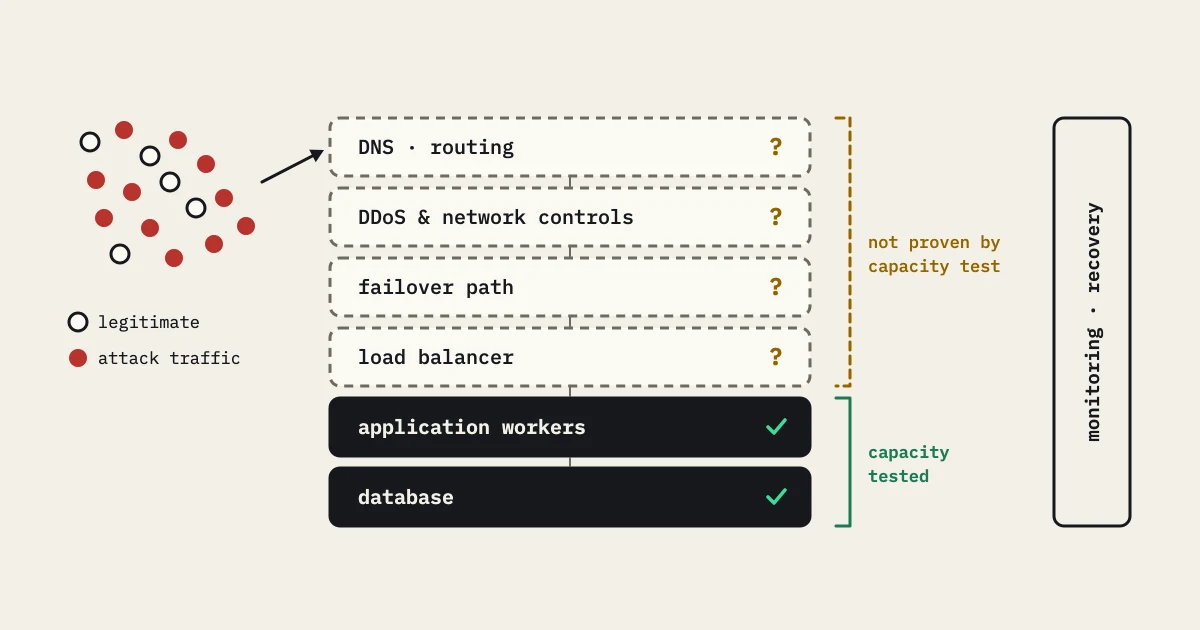
Australia’s 2016 Census online service is worth studying because the official review does not reduce the failure to “the servers were too small.” The Australian Bureau of Statistics reported that the eCensus was taken offline after a distributed denial-of-service attack and that legitimate traffic was within the capacity tested before the event. The operational failure involved a wider chain: network controls, failover, monitoring, and recovery.
That distinction matters for performance teams. A capacity test shows that an application handles a defined workload in a defined environment. On its own, it cannot prove that the edge will classify traffic correctly, that failover will keep the service up, or that responders can see and reverse a bad state. Those are separate properties, and you must test them together when availability depends on them.
What the official record says
The ABS assurance material describes the Census quality and assurance context. The ABS release on the eCensus incident records the service being taken offline after the attack and discusses the decision to protect the broader Census operation.
Those sources are the boundary for this article. They support the lesson that tested application capacity was not the whole availability story. They do not justify inventing a single root-cause metric, a precise user count, or a claim about which one component would have prevented the outage. A careful incident analysis keeps observed facts apart from engineering inference.
Capacity is one layer of a path
A capacity test normally exercises an application with an offered workload: requests, sessions, payloads, and dependencies. It answers questions such as whether response times and error rates remain within an agreed budget at a named load. That is useful, and it assumes traffic reaches the application in the expected form.
An Internet-facing service has more layers. DNS, routing, firewalls, DDoS controls, load balancers, authentication, application workers, databases, queues, and operational tooling can all affect availability. A test that begins behind a trusted internal route may never exercise the controls that decide whether a public request is accepted, challenged, rate limited, or dropped.
The eCensus lesson is to state which layer a result covers. You don’t have to make every test impossibly broad. “The application passed capacity testing” is a narrower and more accurate claim than “the service stays available at peak.” The second claim needs evidence from edge behavior, failure handling and recovery.
Test the traffic decision
Security controls are performance components when they sit in the request path. Define legitimate traffic patterns, burst behavior, connection reuse, source distribution, and request signatures with the security and operations owners. Test in an approved environment with explicit safeguards; never aim a stress tool at a public service without authorization.
Ask whether a control tells allowed workload apart from hostile or malformed patterns while legitimate users still get a working service. How much traffic it blocks is the wrong measure. Measure challenge and block outcomes, control latency, origin load, and operator visibility. A control that protects the origin but makes the customer path unusable still needs a product decision.
Keep this separate from an application capacity run when the safety boundary requires it. A controlled edge exercise can establish the behavior of the protection layer, while a capacity test can establish the origin’s behavior behind an approved route. Join their assumptions in the release plan instead of pretending one test covered both.
Failover needs a real transition
A failover box on an architecture diagram proves nothing. A test should cause or simulate a loss of the active path, then observe detection time, traffic movement, connection behavior, data consistency, and recovery. Existing connections may fail while new connections succeed. Cached DNS or client retries can change the load on the recovering path.
Write down what “available” means during the transition: whether a read-only experience is acceptable, whether writes are retried, rejected or queued, and which errors are expected. Without those answers, a failover test may be declared successful because a health check turned green while users still see broken sessions.
Recovery is its own load event. Clients that failed during an incident can reconnect together, replay writes, or retry without sufficient backoff. Include a controlled recovery wave where it is safe, and watch whether the restored service has enough headroom to absorb it.
Monitoring is part of capacity
A test result that arrives days after a failure does not count as detection. Define signals that reveal the path: edge decisions, origin saturation, error classes, queue age, dependency latency, and synthetic journey health. Alerts should help responders distinguish a traffic surge from a control failure or an unhealthy recovery.
Make the signals actionable. A chart showing total requests cannot tell an operator that one protected route is dropping legitimate traffic. A global error rate can hide a failed login flow. Labels and logs should preserve route, outcome, and transition state without exposing credentials or personal data.
Run the monitoring exercise during the test. Ask an operator to identify the failure from the approved telemetry and follow the runbook. If the only way to understand the event is to inspect the load generator, the production observability path is incomplete.
A better test inventory
For a public peak event, combine several evidence types: application capacity under a realistic mix, edge and abuse-control behavior, dependency degradation, failover transition, recovery load, and operator detection. Sequence them so each test has a safe boundary and a clear owner. Record which assumptions are shared and which are not.
The capacity-planning guide helps turn a forecast into scenarios and headroom questions. The incident adds a second question. If the forecast is wrong or traffic is classified unexpectedly, the service still needs to give users something useful, and people need to see why quickly.
Don’t use the eCensus outage as a slogan against capacity testing. It argues for precise claims. Capacity matters, but availability depends on a whole path and a process. Test the application, the controls in front of it, the transitions between paths and the evidence responders rely on. Then you know what a green result actually means.
Keep the post-test record honest
Use the historical record to identify controls that deserve separate validation. Check that the application path stays available when an allowed traffic source changes, that failover preserves the customer operation, that monitoring detects failure quickly enough, and that recovery works without unsafe manual improvisation. Don’t combine all of those into one dramatic exercise. Start with a controlled rehearsal in an isolated environment, define the abort signal, and verify that test traffic cannot reach an unintended audience. Keep the scenario traffic shape and control state in the result so later readers know what was actually learned. A capacity pass can be retained as evidence while a resilience question remains open. Saying so is honest, and it lets several teams improve the system without claiming that one load test recreated an entire public incident.
Archive the scenario assumptions with the result: the route exercised, the traffic shape, the controls included, the dependency state, the failover action, and the signals an operator used. Mark untested layers plainly. The record stops a later reader from stretching a narrow application result into a claim about the public service. It also gives the next exercise a concrete starting point: preserve what was validated, add one missing layer, and keep safety and authorization conditions visible throughout.
