How to Debug a Load Test Before You Scale It
Prove one user, one journey, assertions, data mutation, and cleanup before multiplying a load-test script into a confusing failure.
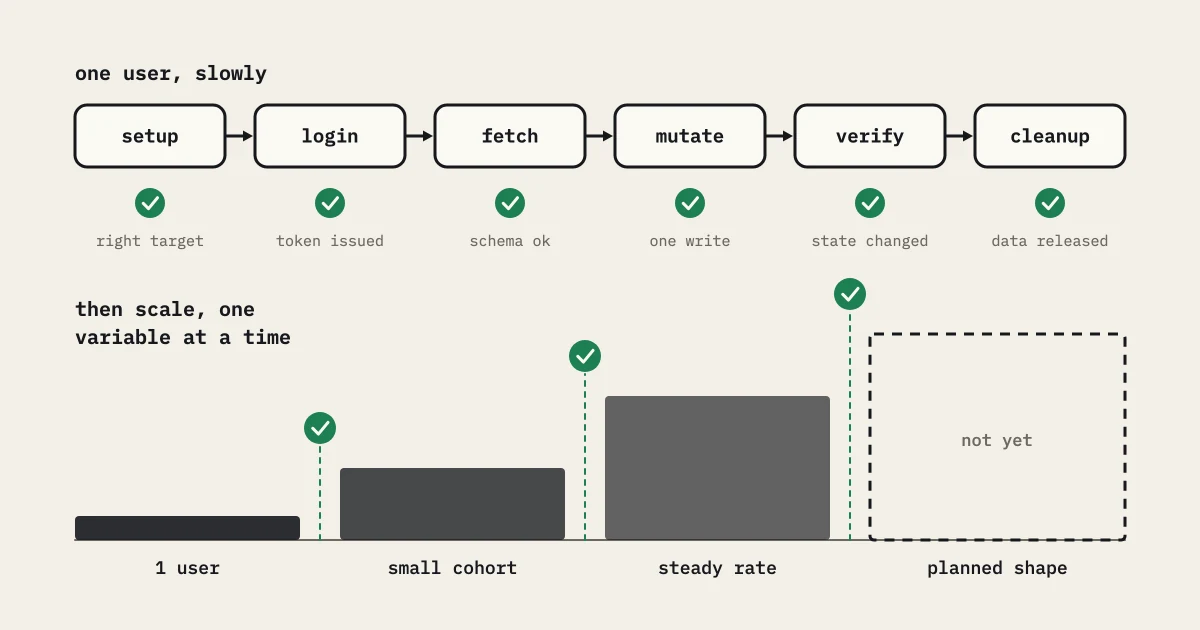
Scaling a broken load test multiplies ambiguity. Before adding workers or virtual users, prove that one actor completes the intended journey, receives the expected business result, and cleans up safely. Then prove the generator can repeat that behavior without changing its meaning.
Begin at the target boundary
Confirm the URL, environment, version, tenant, and authorization. Log the request path and response status without secrets. A 200 response does not prove the operation was valid. Inspect the response shape and business state.
Draw the journey in order: setup, authenticate, fetch, mutate, verify, clean up. Mark each extracted value and where it is reused. A missing correlation token often looks like a target performance failure once concurrency hides the first bad response.
Run one actor slowly
Use one iteration with generous timeouts and no retries at first. Capture the request sequence, response headers, sanitized body, and assertion result. Disable background noise if possible, but note what was disabled. You are diagnosing here, not modelling a realistic workload.
Check redirects, cookies, token expiry, compression, content type, and asynchronous completion. Wait for the stateful operation to finish before verifying it. If the system returns an accepted response and completes later, a request-level 202 is not the final business assertion.
Make failures explicit
Add assertions for status, schema, identity, and state transition. Fail with a label that names the journey and expected condition. Separate transport failures from assertion failures. A test that counts any response as success can report high throughput while it only exercises error handling.
Test the negative path deliberately: invalid token, missing record, duplicate write, timeout, and rate limit. Those responses should be classified intentionally and should not be mistaken for load-test success.
Inspect data and cleanup
Print identifiers, not secrets or personal fields. Verify that the selected record belongs to the test partition and that concurrent users cannot accidentally share a mutable row. Run cleanup after a successful and failed iteration. If cleanup is destructive, use an isolated environment and a tested recovery path.
Finite data pools need an exhaustion rule. A repeated account can warm a cache and serialize a lock. A unique account can create storage pressure. Decide which behavior the scenario intends before increasing concurrency.
Separate target and generator symptoms
At low load, check generator CPU, memory, sockets, bandwidth, DNS, and event-loop delay. If one worker cannot complete one journey reliably, more workers will not repair the flow. Keep a known-good single-user result as a control.
During a small ramp, compare scheduled and achieved arrivals, active users, retries, and client errors. A client timeout can be caused by the target, a network path, or a generator ceiling. Add target telemetry only after the client side is trustworthy.
Increase one variable at a time
Move from one user to a small cohort, then a steady rate, then the planned shape. Change either load, data, duration, or environment between diagnostic runs, not all at once. Record the exact change and expected effect.
Keep the first scale test short. It should find serialization, incorrect sharing, rate limits or a worker ceiling. Once those are understood, run the longer scenario with the approved thresholds and recovery plan.
Preserve the evidence
Keep the test artifact, environment version, data strategy, generator health, and result together. The anatomy of a load-test result gives a practical evidence list. Don’t overwrite the first failure with a “fixed” run. Compare them.
Make scale the last diagnostic step. Prove the semantics first. A boring one-user result is what makes a large result worth reading.
Failure-triage order
When the first scale step turns red, check in this order: the one-user assertion still passes, data allocation stayed isolated, scheduled arrivals equal achieved arrivals, retries did not multiply work, and the target version or dependencies did not change. This order protects the test semantics before the team tunes infrastructure.
For a checkout flow, deliberately return one malformed response in a fixture and confirm the assertion fails. Deliberately exhaust one data partition and confirm the run is marked invalid. These small controls prove that the test can detect its own invalid states. Only then add workers, longer duration, or a higher rate.
Document the first known-good and first known-bad result. A debugging history with explicit changes is more useful than a final script that no longer explains why the original symptom disappeared.
Stop conditions for debugging
Stop increasing load when the test no longer proves its assertion, the data partition is exhausted, or the generator misses its schedule. Stop changing multiple variables when the leading hypothesis is not isolated. A short, valid failure is worth more than a long run whose flow, fixture and environment all changed together.
Once the flow is stable, write a scale hypothesis: “at the next step, database pool wait should rise while generator health remains below its limit.” That gives the run a way to distinguish expected evidence from an unrelated red chart.
Keep a hypothesis table with observation, possible cause, discriminating signal, and next experiment. A timeout with normal target CPU may point to a network or generator boundary, and the table stops you jumping straight to application scaling. Close a hypothesis only when the experiment changes the predicted signal. A chart turning green is not enough.
Use the one-user proof as a control after every significant edit. If the control fails, go back to flow diagnosis. If it passes and the generator reaches the small rate, move to the next scale step. Semantics stay proven before you gather distributed evidence, and each change stays reversible.
Build a discriminating failure record
Before adding workers or increasing the target, verify that the load generator is not the limiting resource. Check its CPU, memory, network, open connections, event-loop or thread-pool health, and local error counts while the target remains at a safe level. Compare requested arrival rate with completed work and inspect whether the generator has begun queueing or dropping samples. Run a small control scenario against a harmless endpoint to separate test-tool behavior from application behavior. Don’t use a fast control result to dismiss target-specific failures. Capture the test revision, runtime settings, data source, and worker health in the same record as the target symptoms. If the generator is saturated, scaling it may be the right next experiment. It is not evidence that the service can sustain more load. Diagnose the boundary you actually measured before changing the architecture.
When a load test fails, capture the smallest interval that contains the first unexpected signal. Record the scenario state, request or iteration identifier, achieved rate, response class, target request rate, and worker health. Then write two competing explanations and one observation that would distinguish them. For example, a client timeout may mean a slow server response, a saturated socket, or a retry that completed after the deadline. A server trace and idempotency check can separate those cases.
Keep the release, fixture, and environment constant while testing the hypothesis. If removing a downstream call makes the timeout disappear, the result narrows the boundary but does not prove the stubbed dependency is healthy. If adding a worker raises achieved arrivals while target latency stays stable, the generator was limiting. If adding a worker changes nothing while queue age rises, inspect the target or dependency instead. Each experiment should change one predicted signal.
Use a stop condition for ambiguous results. Stop when business assertions fail, synthetic writes escape their partition, achieved load misses the requested schedule, or telemetry disappears. Mark the run invalid where appropriate and retain it as evidence of the control that failed. Don’t scale an invalid script to make the chart more dramatic. A larger invalid run only multiplies cleanup and diagnosis cost.
Close the record with a next action that another engineer can execute: fix extraction, partition data, raise worker capacity, inspect a pool, or rerun with a dependency control. Debugging becomes a sequence of reversible experiments instead of an early call for more replicas.
Name the first boundary that failed, because scaling a healthy generator cannot repair a target timeout or an invalid fixture.